


When we think of abuse in marriage, it’s easy to focus on what we can see: bruises, yelling, or physical threats. But financial abuse is one form of domestic abuse that often hides in plain sight, quietly eroding a person’s freedom, safety, and self-worth. In fact, 94–99% of domestic violence survivors also experience financial abuse, according to the National Coalition Against Domestic Violence (NCADV).
If you’re feeling trapped in an abusive relationship, constantly monitored about every penny you spend, or shut out of financial decisions without explanation, this article is for you.
IN THIS ARTICLE:
You deserve financial security and a voice in your financial situation. Let’s start unpacking what’s really going on.

What Is Financial Abuse in a Marriage?
Financial abuse in a marriage doesn’t always come with raised voices or slammed doors. Sometimes, it sounds like, “Don’t worry about the bills. I’ll handle everything,” or it feels like having to ask for every dollar you spend. At its core, this form of domestic violence isn’t just about money and other resources; it’s about power and control within the relationship.
Financial abusers often create an imbalance by limiting your access to money, withholding financial information, or making unilateral financial decisions that leave you financially dependent. This kind of control can make a person feel trapped, even if everything looks fine from the outside.
While some couples naturally divide up household finances, financial abuse becomes harmful when one person in the relationship uses money to control or diminish the other’s autonomy.
Economic Abuse in a Marriage Is Not Always Obvious at First
Financial abuse can also be subtle, especially in marital relationships where one partner earns more or appears more “savvy” about financial matters.
Here are some signs of financial abuse to watch for:
- Being shut out of discussions about bank accounts, financial goals, or financial statements
- Having no access to money without permission or being required to show a receipt for every purchase
- Feeling unable to leave due to financial dependence or fear of losing child support
- Being discouraged from working, building financial literacy, or having financial assets in your name
- One partner withholding money or using it as punishment
Financial abuse occurs in all kinds of relationships. If this sounds familiar, know that abuse is a form of control, not love.
What are the signs of financial abuse in a marriage?
Some common signs include being left out of financial decisions, having no access to money, being pressured to quit your job, or needing permission for every purchase.
Marital Financial Abuse vs. Normal Conflict: How to Tell the Difference
Every couple has financial stress now and then. Disagreements about spending, saving, or making financial decisions are part of navigating life together. But when one person has complete control over the financial resources and uses that control to silence, shame, or limit the other, it crosses a line.
Financial abuse may look like a partner always insisting, “It’s just easier if I handle it,” while secretly excluding you from any financial transparency. This isn’t about being helpful; it’s about power and control.
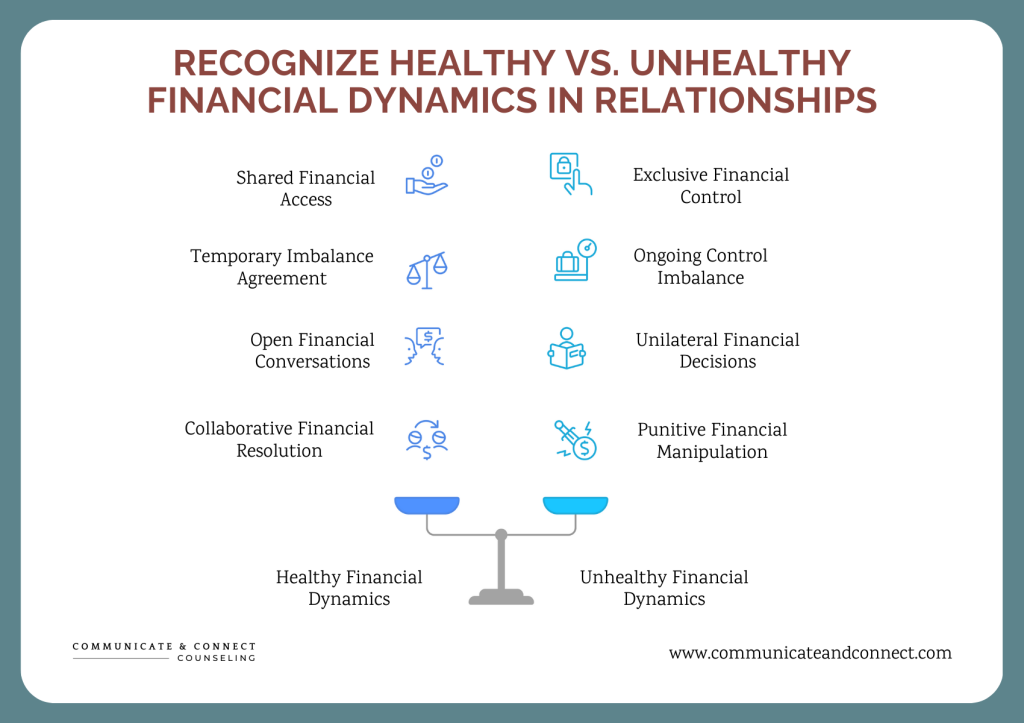
Here’s how to tell the difference between a normal conflict and a form of financial abuse:
- Healthy: Both partners have access to financial records, accounts, and decisions
Unhealthy: Only one partner manages everything and discourages questions - Healthy: Temporary imbalance during life changes (like parental leave), with mutual agreement
Unhealthy: Ongoing control where one partner is left without access to money or resources - Healthy: Open conversations about budgeting and shared financial goals
Unhealthy: One partner makes all financial decisions unilaterally and uses guilt or shame to discourage input - Healthy: Financial disagreements are resolved together
Unhealthy: One partner uses money to punish or manipulate
According to a study by the Institute for Women’s Policy Research, over 70% of victims of financial abuse say it prevented them from leaving an abusive relationship. This form of financial control can be just as damaging as physical abuse or emotional abuse.
In the next section, we’ll walk through some real-life examples of financial abuse, so you can get a clearer sense of what this can look like day to day.
Financial Abuse Examples That Might Hit Close to Home
Sometimes financial abuse doesn’t show up as a big, dramatic event. It shows up in the small, everyday moments that leave you feeling uneasy, confused, or ashamed. These are more than just money disagreements; they reflect a deeper pattern of abuse rooted in power and control.
Here are some common examples of financial abuse that might feel all too familiar:
- Your partner keeps you in the dark about bills, account balances, or major purchases
- You’re threatened with being cut off financially if you “step out of line”
- They take out credit cards or loans in your name or rack up debt as punishment
- You’re guilt-tripped for wanting to share financial decisions or see receipts
- They withhold money for basic needs as a form of control
- You’re afraid to ask questions about spending because of how they might react
If any of these scenarios feel familiar, you’re not imagining things, and you’re not alone. These aren’t just frustrating habits; they’re warning signs of something deeper. In the next section, we’ll look at the emotional toll and long-term impact of economic abuse, and why it can be so hard to name what’s happening when you’re in the middle of it.
What is an example of financial abuse?
One example: Your partner refuses to share financial information but controls all the money, then blames you for “not contributing.” That’s about power, not partnership.
Financial Violence and the Invisible Scars It Leaves
Not all financial abuse is subtle. Sometimes it becomes overt, threatening, and emotionally crushing. This is what many advocates refer to as financial violence, a more aggressive, coercive side of financially abusive behavior that often leaves deep psychological wounds.
Financial violence is a form of abuse that may involve threats, manipulation, and intimidation, using money as a weapon rather than a shared resource.
You might be experiencing financial violence if:
- Your partner uses money to pressure or threaten you during arguments
- You’re told things like, “If you leave, you’ll get nothing,” or “I’ll make sure you never see the kids.”
- You live with a constant fear of homelessness or poverty if the relationship ends
- You’re forced to comply to avoid financial punishment or retaliation
- Emotional damage lingers after conversations about money, even if there’s no yelling
- You stay quiet to keep the peace because challenging their control feels unsafe
This kind of experience of financial abuse often blends into other types of abuse – emotional, psychological, even legal – especially during divorce proceedings.
What is financial violence?
Financial violence is a form of abuse where money is used to control, threaten, or intimidate someone. It can involve withholding funds, making threats about housing or custody, or sabotaging your financial security.
What You Can Do If You’re Experiencing Financial Abuse in Marriage
Realizing you might be in a financially abusive relationship can feel overwhelming, confusing, and even scary. Many people hesitate to name what’s happening because the abuse doesn’t always look the way we expect it to. But this is considered financial abuse, whether it’s loud and threatening or quiet and persistent.
You Deserve Safety, Even When Money Is Involved
The first step is simply recognizing the signs of abuse and giving yourself permission to trust what you’re seeing and feeling. Abuse can take many forms, and no matter how much someone tells you it’s “just how things are,” financial abuse includes any attempt to exert control over your access to money, decision-making, or financial autonomy.
You can begin to protect yourself, gently and safely, by:
- Talking to a therapist trained in domestic abuse or trauma
- Reaching out to a financial advocate or someone you trust
- Calling a legal aid service to understand your rights
- Contacting the National Domestic Violence Hotline at 1-800-799-7233; they can help you make a safety plan
These small first steps can help you move toward clarity without putting yourself at further risk. Remember: an abuser may try to make you feel guilty, confused, or incapable, but the problem is not you.
What to do when someone is financially abusing you?
Start by talking to someone you trust, a therapist, financial advocate, or the National Domestic Violence Hotline at 1-800-799-7233. You don’t have to figure it all out alone, and small steps count.
It’s Okay to Take Small Steps
No one expects you to fix everything overnight. Rebuilding your financial independence and your sense of self can happen one small action at a time.
You might try:
- Journaling or documenting patterns of behavior around money
- Making copies of important financial documents and storing them in a safe place
- Opening a separate bank account if it’s safe to do so
- Talking to a trusted friend, family member, therapist, or support group
- Learning about your legal and financial options before taking action
Financial abusers may try to convince you that you’re powerless, but information and support can be a powerful antidote.
Need Support? Let’s Talk About What You’re Going Through
At Communicate & Connect Counseling, we offer a calm, supportive space to help you explore your relationship without pressure. Whether you’re facing financial abuse or feeling unsure about what’s really happening, therapy can help you untangle the confusion, fear, and ambivalence that abuse often makes so heavy to carry alone.
For couples, marriage counseling can be a place to safely address unhealthy power dynamics. For individuals, it can bring clarity and confidence about what they want and need next.
We’re Here When You’re Ready
Whether you’re hoping to rebuild trust or considering your options, we’re here to walk alongside you. Even when things feel stuck or painful, you don’t have to navigate it alone. Take the next step!


