


If you’ve ever wondered, “Does couples therapy work?” – you’re not alone. Many couples feel unsure whether relationship therapy or marriage counseling is the right step, especially if things aren’t “that bad.” But here’s the truth: couples therapy isn’t just for relationships in crisis. In fact, therapy can help couples build stronger connections, improve communication, and prevent bigger issues down the line.
A 2011 study in the Journal of Marital and Family Therapy found that about 70% of couples see meaningful improvement in their relationship after working with a couples therapist. That’s a hopeful number for anyone feeling stuck or disconnected.
IN THIS ARTICLE:
Let’s talk about how therapy might help you and your partner reconnect.
How Does Couples Therapy Work, Really?
When couples consider therapy, one of the first questions that comes up is “What actuallyhappens in couples therapy?” And it’s a great question because knowing what to expect can make the process feel a lot less intimidating.
Couples therapy isn’t just sitting on a couch and venting. It’s a structured, intentional process guided by a trained couples therapist — often a licensed marriage and family therapist or marriage counselor — who’s skilled in helping partners untangle emotions, improve communication, and rebuild trust.
While individual therapy focuses on personal growth, relationship therapy and family therapy focus on the dynamics between people. The goal is to help couples move from feeling stuck or disconnected to feeling more supported, aligned, and emotionally safe.
What Happens in Couples or Marriage Counseling?
- Sessions are collaborative—you and your partner explore what’s working, what isn’t, and how to reconnect
- Therapy creates a safe space for vulnerability, honesty, and effective communication
- The therapist helps you understand underlying patterns, emotional triggers, and unmet needs
- Common goals include healing from infidelity, navigating decision-making, or managing recurring conflict
And yes, couples therapy can help even when only one partner wants to begin. While it works best when both are open to the therapy process, relationship counseling can still create positive shifts when just one person starts with intention and compassion.
Can Couples Therapy Work for Every Couple?
The short answer is: couples therapy may work for many couples, but it’s not a magic fix for every situation. That said, for couples who go to therapy with openness and a willingness to grow, therapy can absolutely transform the way you relate, communicate, and navigate challenges.
What helps couples therapy work?
- Motivation and honesty from both partners
- A strong working relationship with a qualified marriage counselor or mental health professional
- A clear commitment to work on your relationship, even when it’s uncomfortable
According to the American Association for Marriage and Family Therapy, over 90% of couples report improved emotional health after marriage and family therapy, and two-thirds say it positively impacted their overall physical health, too.
Of course, there are times when talk therapy may not be effective, such as in cases of ongoing abuse, untreated addiction, or when one partner is fully unwilling to participate. Still, therapy can offer clarity about the path forward, even if that path means redefining the relationship.
The bottom line? Therapy can work, especially when you’re both ready to show up, be honest, and do the deeper emotional work together.
What is the success rate of couples therapy?
The effectiveness of couples therapy is strong. Many married couples report better communication and satisfaction after starting therapy, especially when both partners are ready to work.
Benefits of Couples Counseling
Couples often wonder what they’ll actually gain from therapy. While every relationship is different, most couples who seek support walk away with something powerful: a deeper understanding of each other and a renewed sense of connection.
One of the greatest benefits of couples therapy is that it creates space for both partners to be heard without blame or interruption. A skilled counselor will help you develop healthier ways to communicate, manage conflict, and stay emotionally close, especially during life’s stressful or uncertain phases.
Here’s what the research and our experience with couples show:

Couples Counseling Improves Communication
Lack of communication skills in couples often leads to fights and disconnection. Fights and disconnection create a vicious cycle that can take over the relationship. This cycle can appear to come up out of nowhere, even when you thought the relationship was going well.
There are three common relationship cycles that couples get caught in:
- Pursue – Withdraw: In this cycle, one partner is pursuing connection. The pursuing partner longs for connection, but to the other partner, it can come off as critical, demanding, or pushy. When the other partner perceives criticism, they end up withdrawing because they don’t want to be in conflict. The more one partner withdraws, the more the other pursues to close the distance.
- Attack – Attack: In an attack-attack cycle, you again see a pursuer trying to reach for connection with their partner; often, they feel angry and frustrated that they can’t get through to their partner. However, in this pattern, the other partner becomes defensive and critical back. Then both partners are caught in a loop of mutual defensiveness.
- Withdraw – Withdraw: A withdraw-withdraw cycle is the least common, but just as painful. In this cycle, both partners are longing for connection but don’t want to rock the boat. Because of that, they avoid conflict, sweep things under the rug, and grow more and more distant over time. Eventually, they can feel like roommates instead of partners–just two ships passing in the night.
Techniques Used in Therapy to Improve Communication
Marriage counselors help couples enhance their communication skills and express their needs and emotions clearly and without resentment.
- Active listening: This technique encourages individuals to fully concentrate, understand, respond, and then remember what is being talked about.
- “I” statements: This helps express one’s feelings without blaming the partner, thus reducing defensiveness.
- Emotionally Focused Therapy (EFT): A scientifically backed approach, EFT focuses on building secure emotional attachments and is particularly effective in marital therapy.
The long-term benefits of improved communication are profound. Couples who learn to communicate effectively are better equipped to handle future challenges, leading to a more resilient and enduring relationship.
Couples Counseling Improves Conflict Resolution
Couples counseling can help you fight better. There is a lot we could say about fighting in relationships, but we’ll focus on the two opposites on the fighting spectrum:
- Loud Fighting: Couples who are loud fighters are very passionate about their relationships and are usually fighting to regain connection to each other. Some people have been taught that this type of fighting is problematic; however, it is completely natural and normal. Couples who loud fight can be just as healthy as couples who don’t.
- Exception—Abusive Loud Fighters: The only time loud fighting gets problematic is once it crosses from more than aggressive into abuse. The problem with abusive partners is not that they are loud but that they don’t respect personal physical boundaries when they passionately fight for the relationship.
- Passive Fighting: Passive partners often appear cool and collected, very rational. They tend to hold all their anger inside until it simmers out. These fighters are often much quieter and don’t show their anger. Sometimes the anger simmers out in forgetfulness, body posture, and tone of voice, or in biting remarks that seemingly come out of nowhere.
- Exception—Abusive Passive Aggressive Fighters: It is important to note that abusive partners may also be passive-aggressive. The problem here is that passive-aggressive abusers do not care about the emotional impact they have on others. Instead, they may intentionally emotionally hurt and manipulate others to feel in control.
Most individuals do not fit neatly into the loud fighting or passive-aggressive fighting category. Most people use a combination of both strategies at different times, under different circumstances, and at different intensity levels.
What does a couples therapist do?
A couples therapist helps couples understand their cycles, learn healthier communication, and work through difficult emotions. A good couples counselor supports both partners equally.
Techniques Used in Marriage Counseling to Improve Conflict Solving
Mental health professionals often employ various techniques to teach couples how to resolve conflicts effectively:
- Active Listening: Encourages partners to listen actively to each other without interruption, ensuring that each partner’s concerns are fully understood before responding.
- Time-Outs: Sometimes, when emotions run high, taking a short break can help both partners cool down and return to the discussion with a clearer, calmer mindset.
- EFT: EFT focuses on building emotional awareness and empathy, which are crucial for resolving conflicts in ways that strengthen the relationship.
- The Gottman Method: It introduces concepts such as softening the start of conversations and learning to repair interactions mid-conflict, which helps prevent the discussion from escalating.
Regardless of the style of fighting you utilize, therapy for couples can help you de-escalate fights, communicate clearly with each other, and get to the root of problems instead of getting caught up in the whirlwind of fights.
Couples Counseling Builds Deeper Understanding and Empathy
Gaining a deeper understanding and empathy within a marital relationship is not only about enhancing emotional connection but also about reinforcing the overall health and durability of the partnership. Marriage counseling plays a pivotal role in fostering these crucial aspects, which can significantly improve marital satisfaction and stability.
When we don’t have connection, it can cause a host of medical and mental health challenges. The loss of a connection can be traumatic; in fact, it is well-researched that going through a breakup can cause trauma symptoms similar to PTSD but on a smaller scale.
Techniques Used in Therapy to Improve Empathy
Through therapy sessions, couples learn how to step into each other’s shoes and view situations from their partner’s point of view. This deeper understanding can transform the relationship dynamic, turning conflicts into moments of empathy and mutual support.
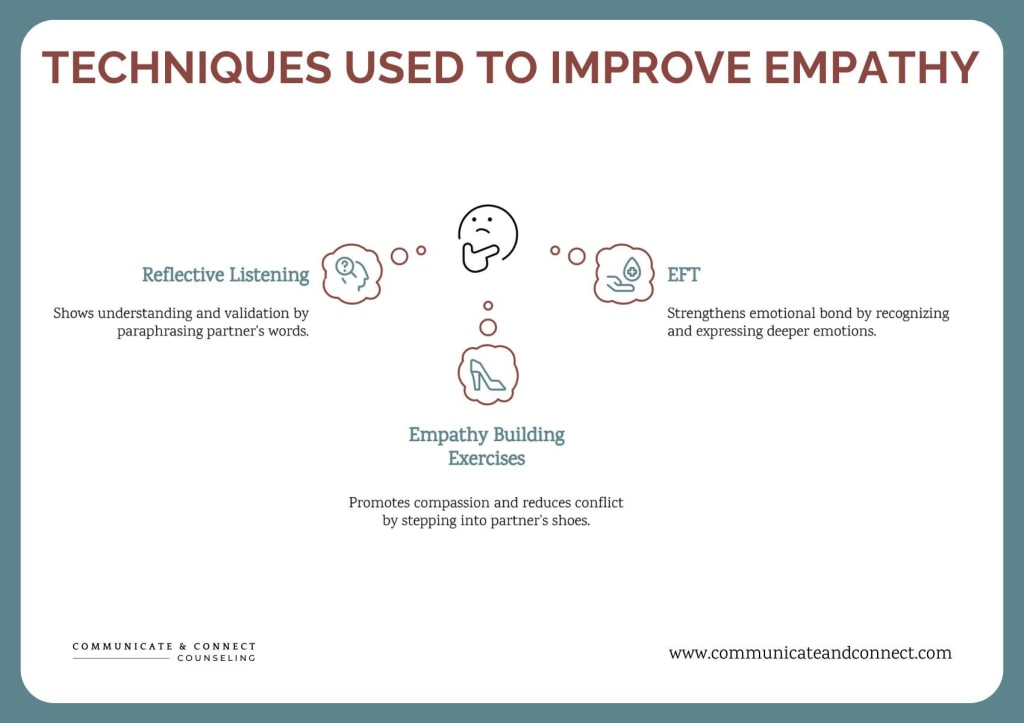
- Reflective Listening: This involves paraphrasing what the other person has said to show understanding and validation.
- Empathy Building Exercises: These exercises help partners step into each other’s shoes, promoting compassion and reducing conflict.
- EFT: This technique helps partners recognize and express their deeper emotions and attachment needs, strengthening their emotional bond.
Over time, the deepened understanding and empathy developed through marriage counseling can lead to lasting improvements in relationship quality. This is particularly significant in maintaining a satisfying and resilient relationship in the face of life’s inevitable challenges and stresses.
Couples Counseling Helps with Trust Building
Trust within a relationship encompasses more than just believing a partner will remain faithful. It involves feeling confident that they will act in your best interest, communicate openly, and respond to your needs and vulnerabilities with understanding and care. The erosion of trust can lead to numerous relationship problems, including communication breakdowns and emotional disengagement.
Techniques Used in Therapy to Build Trust
Marriage therapy can help couples build or rebuild trust. Since trust is the foundation of a healthy relationship, when it’s broken, it can have a devastating impact on the relationship. Rebuilding trust is hard, but couples therapists can help couples along the journey of rebuilding trust.
- EFT: EFT is particularly effective in rebuilding trust because it focuses on enhancing emotional attachment between partners.
- Consistency and Reliability: Therapists often emphasize the importance of consistency in words and actions as a means to build trust. Regular and predictable behaviors from both partners can significantly reassure the reliability and stability of the relationship.
- Transparency: Encouraging partners to share thoughts, feelings, and intentions openly can help rebuild trust. This includes discussing past hurts and future fears without judgment.
- Validation: Recognizing and acknowledging each other’s feelings and experiences is another crucial step in therapy. Validation does not necessarily mean agreement, but shows a respect for the partner’s perspective.
- Shared Goals and Values: Therapists may work with couples to clarify their shared goals and values, enhancing alignment and reinforcing trust.
The long-term impact of increased trust is significant. Relationships with high levels of trust are not only more likely to last but also to provide more fulfillment and support to both partners. Trust is a key predictor of relationship longevity and satisfaction.
Couples Counseling Helps with Intimacy and Sexual Disconnection
Increasing intimacy and emotional connections is one of the many benefits of couples counseling. This is an important aspect of marriage because many couples divorce due to growing distant and drifting apart. This distance and disconnection can lead to loneliness and increased dissatisfaction with the marriage.
Intimacy involves a deep understanding of each other’s needs, desires, and emotions. It requires a level of vulnerability and trust that allows both partners to feel safe and valued. According to the American Psychological Association, intimacy is not solely about physical closeness but is profoundly about emotional connection, which is essential for a healthy marriage.
Techniques Used in Therapy to Enhance Intimacy
Marriage counselors help couples figure out what is causing the disconnection and work towards rebuilding the intimacy and emotional connection in the relationship again. This may involve:
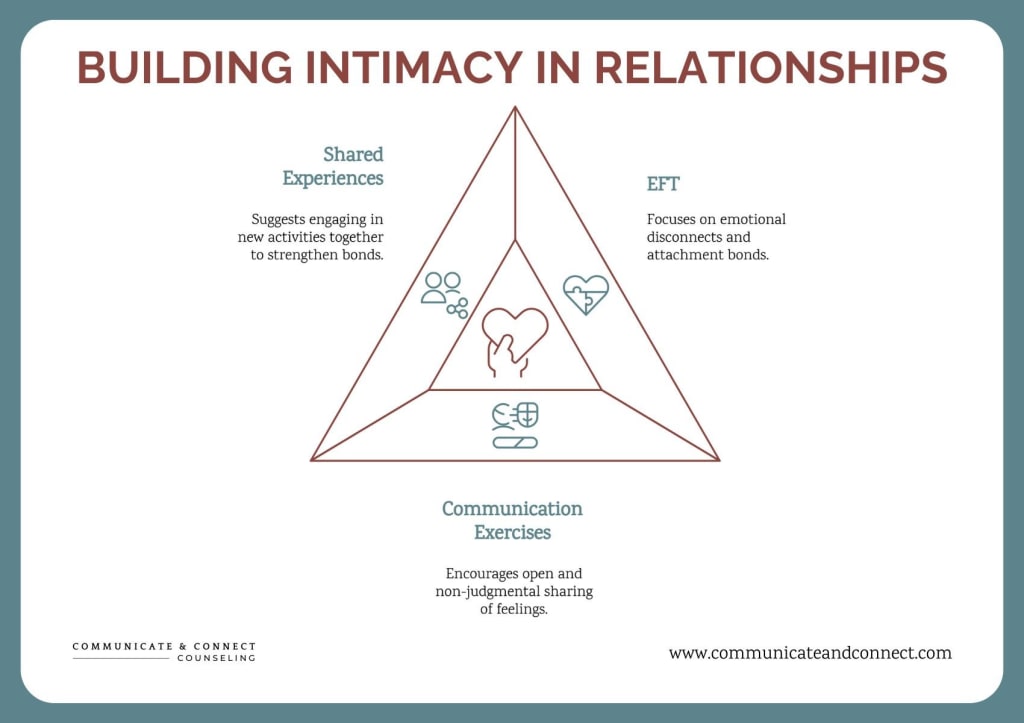
- EFT: EFT is designed to address the emotional disconnects and strengthen attachment bonds, which are crucial for intimacy.
- Communication Exercises: These exercises encourage partners to share their feelings, desires, and concerns openly and without judgment, fostering deeper emotional intimacy.
- Shared Experiences: Counselors might suggest engaging in new activities together to strengthen the bond and create new shared memories.
It is more common to feel sexually disconnected when there is an emotional disconnection. A common problem couples face in this situation is called sexual desire discrepancy. This is often due to how people try to regain connection.
For some individuals, when they feel disconnected from their partner and are longing to reconnect, their sex drive increases. This is often because they like to use sex as a way to reconnect with their partner. They want to use sex as the kindling to start the fire of emotional connection burning again.
For other individuals, when they are feeling disconnected and wanting to regain closeness, their sex drive actually decreases until the connection is repaired. These individuals do not find sex to help reconnect with their partner. Instead, they see great sex as an activity that happens after a strong emotional connection. Here, sex is the massive bonfire and only comes after the emotional connection has been building for a while.
Neither approach is right or wrong—they are just differences in preference and how someone connects to others. The hard part comes in when one partner wants sex to reconnect, and the other partner wants to reconnect before sex. The conversation between couples often ends up being about whether or not to have sex instead of the desire to reconnect. This often makes both partners feel pushed away from each other, not valued or wanted, and can create more distance.
The key point to remember is that both partners are longing to be reconnected and close again. Couples therapy can help change this pattern, help you understand each other, and help you change the conversation from sex to the underlying mutual desire for connection.
The Sum of Benefits of Couples Counseling: Strengthening the Relationship
Relationships are like plants-they need to be watered and taken care of to continue to grow and flourish. By improving communication, mutual understanding, and enhancing problem-solving and conflict resolution skills, couples can develop stronger relationships prepared to last a lifetime.
Each couples therapy session builds on the couple’s strengths, addresses their weaknesses, and fosters a healthier, more fulfilling partnership. Furthermore, couples counseling plays a crucial role in reducing the divorce rate, offering couples the tools to manage not just the everyday stresses of married life but also more profound issues that, if left unchecked, could lead to separation.
For couples contemplating therapy, the myriad benefits of couples counseling underscore its profound potential to transform and strengthen relationships, making it a worthwhile endeavor for anyone looking to enhance their partnership.
Is relationship therapy only for struggling couples?
Not at all. Relationship therapy helps good couples grow stronger and prevents small issues from becoming bigger problems. Therapy to strengthen connection is common.
So, Is Couples Therapy Worth It?
If you’re asking whether couples therapy is worth it, you’re already thinking with intention, and that’s a good sign. While it can feel like a big emotional and financial commitment, many couples find that the value far outweighs the cost, especially when it comes to long-term relationship health.
Couples therapy isn’t just for managing crises. In fact, many couples who seek therapy aren’t fighting at all; they’re looking to understand each other better, communicate more effectively, or prevent small frustrations from becoming bigger relationship problems.
Research shows that early intervention can be incredibly effective. According to the Gottman Institute, most couples wait an average of six years of unhappiness before going to therapy, but by then, patterns can be harder to break. Starting sooner allows you to strengthen your bond and build the emotional tools you’ll carry into every chapter of life.
Whether through in-person or online therapy, the process itself—when guided by a licensed, compassionate professional—can transform the way you relate. So if you’re wondering when to consider couples counseling, the answer might be: before you think you need therapy.
Let’s Talk About What You Need to Feel More Connected
When couples are feeling stuck, disconnected, or unsure how to move forward, Emotionally Focused Therapy (EFT) offers a compassionate, science-backed path toward healing. EFT is one of the most effective forms of therapy for relationships because it doesn’t just address surface-level problems; it goes deeper to strengthen the emotional bond between people in the relationship.
AtCommunicate & Connect Counseling, EFT is at the heart of how we support couples. Whether you’re facing long-standing relationship issues, working through a recent rupture, or just want to build a healthier relationship, this approach helps good couples become even stronger.
Our licensed mental health professionals are trained in EFT and create a non-judgmental space where you can openly and honestly explore what’s really going on beneath the surface. We believe every couple deserves to feel seen, heard, and supported.
Let’s begin that journey together. Reach out!


