

Episode Outline: Secrets to a Successful Marriage with Veteran and Military Spouse Tina Erwin
Episode Summary of “Secrets to a Successful Marriage with Veteran and Military Spouse Tina Erwin”
What if the secret to a successful marriage wasn’t about being perfect… but about learning to love each other through the mess, the distance, and the fear?
If you’re a military spouse or in any kind of long-distance or high-stress relationship, you know it’s not always easy. The deployments, the uncertainties, the constant adapting. And yet, somehow, we still long for connection, for belonging, for a love that lasts.
In this episode, I sit down with Tina Erwin, a retired Naval Commander, Navy wife, and mother, who’s been married for over 50 years. Through real stories and raw reflections, she shares the secrets to a successful marriage especially when life pulls you in different directions.
From navigating fear when your spouse is in danger, to reclaiming your identity in the chaos of military life, Tina offers more than advice. She offers hope, humor, and hard-won truth.
Whether you’re just starting your military marriage, deep in the trenches, or wondering how to hold it all together…
This conversation is your gentle reminder that the secrets to a successful marriage are rooted in love, faith, communication and the courage to grow together.
Don’t forget to check out our free 10-week relationship email course. This email course is really designed for people who are maybe having trouble with communication or connection in their relationship and helping them develop some quick wins right away to start improving it.
Guest Speaker Bio – “Tina Erwin”
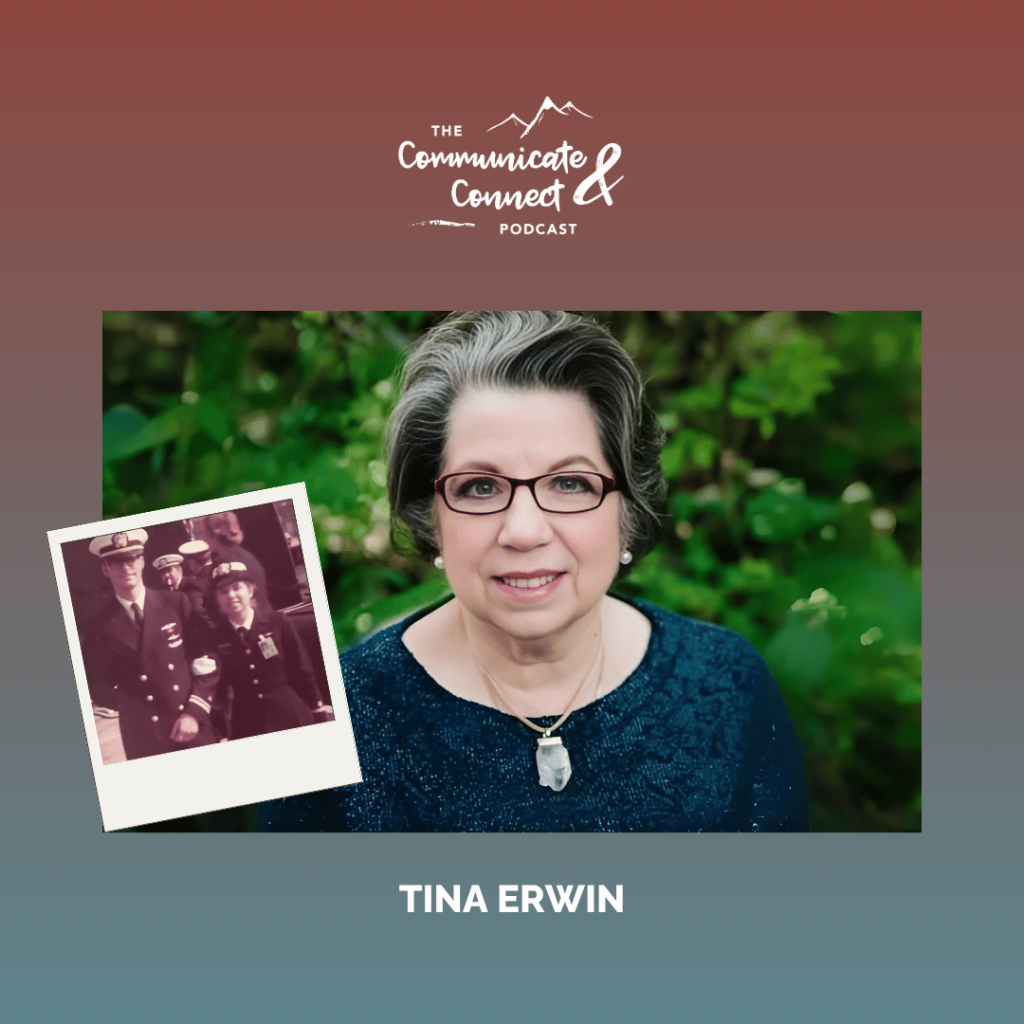
Navy Wife • Retired Naval Commander • Spiritual Author & Mentor
Tina Erwin brings a powerful and rare dual perspective as both a retired Naval Commander and a dedicated Navy wife. With over 20 years of experience in the elite Submarine Force, Tina and her husband served side by side in one of the most demanding branches of the military, including assignments at overseas duty stations.
Now a grandmother to her Air Force son’s children in England, Tina continues to serve through her writing, mentorship, and spiritual insight. Throughout her decades of military life, she’s helped countless service members and spouses navigate deeply personal challenges from deployment stress, addiction, and suicide, to the everyday overwhelm of parenting and relationships under pressure.
She holds a Master’s Degree in Business and Management, and is the author of several books available on Amazon, covering topics from the spiritual to the deeply practical.
Whether she’s guiding grieving families, mentoring new military spouses, or teaching others how to find peace through uncertainty, Tina’s life mission is simple but powerful:
To be of service until her very last breath.
Learn more about Tina’s work:
– TinaErwin.com – Books, insights, and legacy
– GhostHelpers.com – Spiritual tools and healing
– Explore her books on Amazon
– Connect with her on LnkedIn
– Subscribe to her Ghost Helpers YouTube Channel here
Free Relationship Pattern Assessment
Many couples assume they have a communication problem when they’re actually stuck in a relationship pattern that keeps creating the same conflict.
Take the free Relationship Pattern Assessment to discover what pattern may be keeping you stuck and learn what to focus on next.
👉 https://pages.communicateandconnect.com/relationship-quiz
Episode Transcript for “Secrets to a Successful Marriage with Veteran and Military Spouse Tina Erwin”
This podcast is sponsored by Communicate and Connect Counseling, where we have a team of therapists who provide individual couples and family therapy services, all tailored to meet the needs of military and veteran families. To learn more about our services, visit www.communicateandconnect.com.
Welcome to the Communicate and Connect podcast for military relationships with your host, Elizabeth Polinsky, a military marriage counselor. If this is your first time listening to the Communicate and Connect podcast, please take a second to go rate review and subscribe to make sure you get all our future episodes.
We also really wanna know what it is you love about our podcast, and if for some reason you’re not loving it, we wanna know that too because we’re committed to providing the best quality content to help you improve your relationships.
You’re listening to episode 65, Secrets to a Successful Marriage with Veteran and Military Spouse, Tina Erwin
Tina Erwin: Hi, how are you? So glad to be here.
Dr. Elizabeth Polinsky: I’m glad to have you here too. Thank you for being willing to be on the podcast. And one of the things that, really stood out to me and why I was excited to have you here is because you can really speak to the experience of being both a service member and also a military spouse.
Dr. Elizabeth Polinsky: And navigating different relationship challenges that come up from both sides of that. So maybe, we could start with just having you share a little bit about yourself and your experiences and who you are so everybody could get to know you some.
Tina Erwin: Well, thank you.
Meet Tina Erwin: A Veteran’s Journey
Tina Erwin: I joined the Navy in 1972 at the height of the Vietnam War, so I’m pretty ancient and I joined the Navy to find a husband.
Tina Erwin: I don’t know how to be any more honest than that. So if we’re telling the truth, that was why.
Tina Erwin: I also wanted to travel, and I did not wanna spend my life as a martyr demanding equal pay with a man. It’s the seventies. You have to understand, looking at life from yesterday with yesterday’s eyes.
Tina Erwin: They had to pay you the same, it was law. So I didn’t have to fight that. All I had to do was be as smart and clever as a guy and, you know, I might make it. Yeah. And so had a, master chief petty officer help me at the recruiting station in Greensboro, North Carolina.
Tina Erwin: I was the first officer in the history of recruiting in North Carolina.
Tina Erwin: And he said, you’re a little overqualified to enlist. And I said, I wanna be an officer. He walked my paperwork through the Pentagon in the seventies. The guy was, to this day, I always say a prayer for him because he changed my life.
Tina Erwin: And my very first day at my very first duty station, I was engaged by the time I got to my first duty station, which was New London, Connecticut.
Tina Erwin: Engaged with Ring.
Love and Marriage in the Navy
Tina Erwin: And that very first day I walked into Bachelor, officer Quarters, the lounge, and there’s this guy that looks like Superman, he has on the birth control glasses, and he’s tall and he’s handsome, and it’s like, oh my gosh, am I engaged to the wrong guy? And I was Oh, and I needed the guy I was engaged to to get me to New London because I was gonna be a communications officer at Electric Boat Division.
Tina Erwin: And when I met my husband, I knew this was the guy. It was an instantaneous knowing. Wow. And I found a way to engineer it so that the guy I was engaged to broke the engagement and he dumped me because he was a good man. Yeah. He didn’t deserve for me to make him feel bad.
Dr. Elizabeth Polinsky: Yeah.
Tina Erwin: I enabled him to tell everybody that the things that I wanted were unreasonable, like five Siamese cats, and I was gonna resign my commission.
Navigating Military Life and Relationships
Tina Erwin: I started dating my husband Troy in June. He was at sea most of the time. We were engaged by August and we eloped in October. All of this took place in 1973 and he was kind of stunned at how quickly things went, but I had this feeling that we needed to get things done in this lifetime and we had to hurry up. Yeah.
Tina Erwin: And he had orders to a submarine in the Philippines. he said, will you write to me. And I said, no dude, you interested in me? Get your orders changed to a boomer outta New London, a ballistic missile submarine.
Tina Erwin: And he did. And I thought, okay, the guy’s serious. Wow. That’s huge. Thank That was just huge. So we eloped, which was very romantic and super cool.
Tina Erwin: And then we didn’t have a lot of outside influences. And a lot of the outside influences are family and not all family members like the fact that you’re married to someone who goes to sea.
Dr. Elizabeth Polinsky: Yeah. So you
Tina Erwin: have an outside influence as a pressure. My outside influence was that my mother-in-law did not like me ’cause she thought all women officers were prostitutes. So that was a little bit of a wrinkle.
Dr. Elizabeth Polinsky: Yeah, that’s a big wrinkle, that stress.
Tina Erwin: Yeah, it was really tough.
Tina Erwin: However, we eloped in October and he went to sea in January.
Tina Erwin: And so for the first three years we had never spent longer from the time I met him longer than 90 days in a row together. And during that time I worked as a communication officer and I receded for all communication and crypto gear for all 60 88 class new construction submarines that were being built at Electric Boat Division at General Dynamics, and.
Tina Erwin: It was a very interesting job and I needed a lot of different advice from a lot of men and who really helped me, but they still didn’t know what to do with women. And Troy and I we were one of the very first married officer couples in the Navy. I think there were only like a hand like maybe 10 of us in 1973.
Dr. Elizabeth Polinsky: So pretty groundbreaking. You guys were figuring it out how to do it the first time.
Tina Erwin: Then, all of a sudden now I’m an officer’s wife and there’s a ward room and was weapons officer on Benjamin Franklin Gold, and it was a two crew submarine system, which they still have today with ballistic missile submarines.
Challenges and Support Systems
Tina Erwin: And when I grew up, my mother had no friends. I did not know how to make friends. I did not know how to entertain. I did not know what was expected of an officer’s wife. So I have my day job. And now I’m a junior officer’s wife and I don’t have a clue what to do. And a whole sector, the reputation was that military wives were awful and bitchy and gossipy and terrible.
Tina Erwin: And I thought, well, what? That’s not true. Why would we prejudge a whole sector of the population? But what if that’s not true?
Tina Erwin: my commanding officer threw a wedding shower for us after we announced we were getting married. ’cause you had to get permission. And I applied for permission and I didn’t get it.
Tina Erwin: And I said I’m not waiting. We got married ’cause we only had so much time. ’cause you can’t be stationed together unless you’re married. I had to talk the detailer into sending me to New London because I showed her my engagement ring. It was the only way I got to New London so that I could meet Troy
Tina Erwin: and each of these wives looked at me like, you are so weird.
Tina Erwin: You’re gonna walk both sides of the road here. it’s a really cool experience.
Tina Erwin: So my wardroom was extremely gracious. And then I met the Wardroom for Benjamin Franklin. And I loved those women. A lot of them were my age. Some of them had kids. The captain’s wife took me under her wing.
Tina Erwin: She taught me, I observed, what does it take to entertain? What is this like? And so this was really cool. So I held a party the day the guys went to sea. Because Woo-hoo. The beginning of the end, you know, we’re starting it.
Tina Erwin: And we opened up the party to officer and enlisted wives. And we’re only talking 120 people.
Tina Erwin: Not every guy was married.
Dr. Elizabeth Polinsky: Yeah.
Tina Erwin: And then I held halfway night parties and everybody brought something and man, I’m learning how you entertain. Yeah. Because if you’re in the military, one of the big elements is you have to entertain and you have to go out of your way. You have to come out of yourself to make friendships, to build that bond.
Tina Erwin: I’ve watched my daughter-in-law, ’cause my youngest son is in the Air Force and she and I have talked about this and she has built those bonds and she built friendships I have two truly amazing daughters-in-law.
Facing Fear and Building Resilience
Tina Erwin: And then what I watched is.
Tina Erwin: Just because your husband or your wife isn’t physically present doesn’t mean that problems stop.
Tina Erwin: I. dropped my husband off to go to sea and I came back and I turned the faucet on in my kitchen and the entire hardware fell apart and I had a geyser in the kitchen.
Dr. Elizabeth Polinsky: I feel when my husband was deployed, the same thing happened. Like anything that could go wrong did go wrong, just right when he left.
Tina Erwin: Exactly. And the couple who lived next door to us, her husband was on an opposite crew. So when Troy was at sea, her husband was home. so each of the husbands would help the wives with the problem and you know, we would make sure that we brought her over for dinner and that she wasn’t alone. And yeah,
Dr. Elizabeth Polinsky: so
Tina Erwin: important that relationship.
Tina Erwin: The military is only about people. People think it’s hardware and the mission, but it’s really about relationships and no one can create those successfully. But you
Tina Erwin: and I observed that when I married my husband. I had to come to terms with, he is not going to be home every day.
Dr. Elizabeth Polinsky: Yeah, but you’ll be alone a lot as a military spouse.
Tina Erwin: You have to come face to face with the uncertainty of it.
Tina Erwin: I remember one coffee that I held or I went to, one woman is just bitterly complaining about her husband, and I said, you know, one, he’s not a doctor. If he were a doctor, he would be on call and he would still never be home. He’s not a traveling salesman.
Tina Erwin: Believe me. You know exactly where he is and he’s with the finest men. Literally money can buy in the highest tech equipment with the most wonderful other fellow officer and enlisted men he could possibly be with. Yeah. He comes home to you and he has only eyes for you. We agreed to this when we got married
Tina Erwin: and of course there was a hush in the room because that was not necessarily a popular thing to say.
Tina Erwin: Mm-hmm. He said, you know, I agreed to this and this gives me an opportunity to have my identity. I’m not the assistant weapons officer’s wife, I’m an innocent. I have an identity and I think that if I were to offer something, it would be, and my, again, you know, Monica and I talked about this, that she has an identity too, she’s working and I was working and then I noticed a lot of these other women, they all had jobs and they went to their jobs and then we would get together based on those schedules and so
Tina Erwin: having that identity kept your marriage far more in balance?
Dr. Elizabeth Polinsky: Yes.
Tina Erwin: To have a, you have a mission too.
Tina Erwin: I still have military mindset. because I’m a single parent .
Tina Erwin: He went to see after we retired, so my husband spent probably five full continuous years at sea, spread out over a long time.
Tina Erwin: But when he retired in 95 and then spent another 10 years at sea working for research ships and captain of an oil rig and all kinds of things.
Tina Erwin: But only the military has a sense of the camaraderie of other spouses. Yeah. In the seventies there were no male spouses because we were one of the very first officers.
Tina Erwin: I was, you know, like one of those.
Mentorship and Community Support
Tina Erwin: I noticed as there were new wives, we would all try to take that new person under our wing. I volunteered. I said, look, you have a problem with the Navy. Let me know. Here’s the terminology. I can explain things for you. Don’t believe rumors. Rumors will eat you alive.
Tina Erwin: Don’t believe them only either. Talk to the squadron. Or talk to the captain’s wife, she’ll tell you what you can and you can’t do. Respect the need to know. If your husband comes home and he can’t tell you what he did or where he went, sometimes you really don’t wanna know.
Dr. Elizabeth Polinsky: So
Tina Erwin: I’m hearing
Dr. Elizabeth Polinsky: really like orient new spouses in to what military life would be like.
Dr. Elizabeth Polinsky: And I’m hearing that’s kind of was your experience too, like once you got married, The spouses that were part of his group really mentored you. And then I’m hearing you went on to then mentor new spouses that were coming in and Yes, we played a role.
Tina Erwin: We played a role, and I did this with, at the commands that I had where, you know, we helped each other where it was officers and enlisted.
Tina Erwin: And, when you. think it’s difficult when your husband goes to sea, and you’re in the United States, it’s a different ball game when you go overseas.
Tina Erwin: And Navy, and I think they still do this. I’m seeing the Air Force still does it. We’ve closed a lot of bases. We closed Holy Lock Scotland and we closed Road to Spain.
Tina Erwin: We still have a presence in Italy and shape headquarters in Belgium and England and several, I know we have a presence in Kuka, Japan and Guam, we still have a presence in many places.
Overseas Challenges and Common Issues
Tina Erwin: If you’re going to go overseas, you have to remember you are the foreigner. They’re not going to adjust to you.
Tina Erwin: You have to adjust. And if you’re newly married and that’s your first duty station, that is a massive life crisis.
Tina Erwin: Yeah. So there, there are many life crises in a person’s life, getting married, a death, a divorce, a new baby moving, but moving overseas is massive. Okay? And if your marriage is shaking and you move overseas, it can really stress your marriage.
Dr. Elizabeth Polinsky: so this was gonna be, one of my questions for you was about from your experience, what do you see are really common challenges that military couples face? And I’m hearing this is one of them, all of the regular life crisis moments. And then you have extra unique ones with military life, like going and living overseas.
Tina Erwin: you have the issues of danger? And. My husband took a submarine. He was the executive officer for a submarine tender during the Iran Iraq war. He was gone eight months, which was a long deployment. Usually we were at three and a half or five, but eight months was really long and they were, you know.
Tina Erwin: I don’t know how many, a hundred miles at sea. And they could feel the oil cover, the ship from the fires from Saddam Hussein, he said all those oil fields on fire.
Dealing with Fear and Uncertainty
Tina Erwin: And there were a lot of people who were very afraid for their family members, for their, husbands. And they were going, why are we sending a submarine tender to the Middle East?
Tina Erwin: Because that submarine tender had the finest crew members, officer and enlisted on board, and they were fixing destroyers in record time. They were outfitted with equipment. so now you not only have the absence of your spouse, now your spouse is in a war zone. So you have this thing called fear that gnaws on you at night and haunts your days.
Dr. Elizabeth Polinsky: Was there anything you did to help you with that fear?
Tina Erwin: Yes, and it didn’t hit me until my husband was on research ships and he had super crazy crew members. Six inch pipes that were open to the sea, dead in the water with zero angle on the bow of super tankers that were on autopilot. And Adam, I fuel in the engine compartment and he was almost blown to bitch.
Tina Erwin: There wouldn’t even have been a body to bury. And I realized that
Tina Erwin: every time he came back, I was angry and I was punishing him for making me so afraid. And then one night I had a come to Jesus moment, and I’ll use that term because it’s a matter of faith. I don’t care what somebody’s faith is.
Tina Erwin: But it’s a matter of a divine connection. And I realized that my fear was owning me.
Tina Erwin: And if people don’t take anything else from this podcast, I hope that they will take this.
Tina Erwin: Because when fear owns you you are crippled by it. And I found that that was happening to me. And I’m not a person that gives up power easily when it comes to this kind of thing.
Tina Erwin: So I did a practice that anyone can do. And this is how it worked. And it took me all night.
Tina Erwin: I had to face my biggest fear. What was my biggest fear?
Tina Erwin: Mrs. Irwin, I’m sorry. There’s been an accident. There’s a phone call in the middle of the night. That was my biggest fear.
Tina Erwin: I’m so sorry to inform you.
Tina Erwin: and I found that I burst into tears in the middle of the night in bed, and I cried and I pre grieved that potential phone call.
Tina Erwin: Because what you fear the most, you attract. It’s a spiritual law. I wanna attract something terrible to my husband and I had control over that, and so I lived through having to call each of the children.
Tina Erwin: Tell them something has happened to your father. And then I pre-live everyone gathering, and then we went through settling the estate and then we went through what was my life going to be like if he wasn’t there. And I realized that a lot of my fear was about what was gonna happen to me. Yeah. What was going to happen to the children.
Tina Erwin: And I realized that. The children were going to be all right. I was going to be all right. I would see him again, and my personal belief, he and I have had many lives together and we got to have another one. This life, I would always love him, but I needed to stop being afraid because at the end of the day.
Tina Erwin: I was still going to be all right and he was going to still be with God,
Tina Erwin: and yeah. I didn’t need to be afraid anymore.
Dr. Elizabeth Polinsky: Yeah. I’m hearing a few components in what you’re sharing. There’s the personal faith piece of like, I know we’re gonna be together. Again, no matter what happens. And that was a source of comfort.
Dr. Elizabeth Polinsky: And then there was also this piece around like, I don’t want fear to own me and I don’t want to have like a self-fulfilling prophecy. So I’m gonna face my fear and I’m gonna make plans for, you know, what if the worst case scenario happened, how will I live? What will I do? and just having that plan helped reduce the fear. It’s not so scary if I know what I’m going to do in the worst case scenario.
Balancing Navy Life and Family
Tina Erwin: that’s very true I applied that to my children driving and one of the biggest sources of anger or conflict in a marriage is sometimes the spouse doesn’t realize how much fear is living within them.
Tina Erwin: And then they project that fear onto their spouse who has a mission. They love what they do. I love the Navy. I love what I did, and sometimes the things I did were they could be dangerous, it wasn’t in a war zone and. Troy never worried about me. I managed two kids and we adopted a third.
Tina Erwin: And the house and my career and all the things that happened pretty elegantly. He never once got a phone call because I felt like I could control my environment, but I couldn’t control what was happening at sea. Yeah. And it was me coming face to face with myself. Letting go of the illusion of control and it was really helpful.
Tina Erwin: I minored in psychology and sociology, so I’d studied so much of this myself.
Facing Fear and Embracing Love
Tina Erwin: Fear is never your friend. And I didn’t want to give my husband or my children, especially when they’re teenagers, my fear, I gave them my love and my confidence. Oh, that’s beautiful. And it changed everything in our marriage.
Tina Erwin: It changed the entire atmosphere of the house. I could control that just through the concept of love and confidence and courage.
Tina Erwin: Sorry, I was on a soapbox. I’m only five foot one. That’s okay. The big soapbox.
The Impact of Fear on Relationships
Dr. Elizabeth Polinsky: I like the soapbox that you’re on, Tina, because, it feels really relevant to relationships because when I’m working with couples, fear is a really big component.
Dr. Elizabeth Polinsky: Of what is driving a lot of the conflict of course there’s like surface level conflicts, but, how do I deal with my own fear when it comes up? it is a core, dilemma that people are struggling with just individually in life. How do we deal with our own sense of fear? But also as it relates to relationships, and then how do I talk to you when my fear comes up?
Dr. Elizabeth Polinsky: so this feels really significant to me what you’re saying, which is you sort of had to face your own fear. You had to find some way to, embrace it, accept it, make plans around it, versus, Just staying in the fear or trying to distract away from it, which is what a lot of people do I think
Tina Erwin: too much fear creates these elements.
Tina Erwin: I’m choosing my words carefully here because the words matter.
Managing Adrenaline and PTSD
Tina Erwin: when fear zaps you, you’ll see something on television or you’ll think about that person and you get this zap of fear. You get a zap of adrenaline, and that adrenaline is not good for the body. Adrenaline has its place, but you have to wash that outta the body.
Tina Erwin: And I, use something called Noni Juice, which is a blood cleanser,
Tina Erwin: there’s a whole discussion on PTSD and how to help with returning spouses and PTSD.
Tina Erwin: When you stop the ping of adrenaline in the body, ’cause it’s a physical manifestation and it’s toxic for you, you’re projecting it and your children feel it.
Instilling Confidence in Children
Tina Erwin: Everyone around you feels it and you may feel you can’t control it. But if you go to a place of love and faith, I don’t care what your faith is it doesn’t matter. Your faith is a belief and in love. Do you love This man or woman? Do you love your children? Yes.
Tina Erwin: Then give them your courage.
Tina Erwin: Give them your confidence.
Tina Erwin: Give them the grace of your love every moment.
Tina Erwin: I’ll give you another example. Troy was at sea a lot and one night my teenage son and my daughter, they’re four years apart at San Diego in the rain and nobody knows how to drive in the rain in San Diego and they’re gonna go Christmas shopping and I didn’t want them to go.
Tina Erwin: And so they get in this big van. And they’re sitting in the car and James looks at me and I said to my daughter, I want you to pay attention to your brother. He is an outstanding driver. You’re gonna be driving soon. I want you to pay attention to how careful, how thoughtful, and how wise your brother is as a driver.
Tina Erwin: I have absolute faith in him. You two are gonna have a great time. And my son starts to chuckle and he says, I know what you’re doing. And I said, I hope so. I hope you do. I absolutely believe in you. And when they got back, my daughter says, mom, James is amazing. He is the best driver. You were right. I’m so.
Dr. Elizabeth Polinsky: Yes. I love that. Even though there was like maybe a little bit of nervousness with the rain and other people driving you Yes. Were able to give him your belief in him. To show him, , that we could all have courage and that you believed in his ability to handle a difficult situation
Tina Erwin: it’s really important.
Navigating Marriage Dynamics
Tina Erwin: And basically when your spouse goes to sea, he or she is believing in you to handle everything there’s some other caveats that go with that because, you know, my husband would be on a Boomer patrol and he’d come back and he said, I, I’ll take over the managing the checkbook now. And that didn’t go over well.
Tina Erwin: I said, because we can’t go back and forth.
Dr. Elizabeth Polinsky: Yes. Hard to have control and then not have control and then like, wait, I’m used to that.
Tina Erwin: We did some marriage maintenance and men understand maintenance and one of the things I learned is how to speak to men so they can hear you.
Tina Erwin: I observed how men speak to each other. I was the executive officer and I’d say you never say, oh, I have a doctor’s appointment ’cause my child is sick. You say, Hey, I got a doctor’s appointment. I’ll be gone for a while, I’ll be back. Children didn’t come in your seabag, you don’t have to mention it.
Tina Erwin: You have a hairdresser’s appointment and you might be a while, say, I’m leaving early. Gotta get a haircut, man. I understand that all day long.
Tina Erwin: If you say we’re having a disagreement, I think we need to stand down male term and have some marriage maintenance. Oh, men understand maintenance.
Tina Erwin: You’ve gotta maintain your equipment. You have to maintain your relationships too.
Dr. Elizabeth Polinsky: Yeah.
Effective Communication with Spouses
Tina Erwin: So if you start to listen to how men talk and how men think. Your ability to communicate will be better.
Tina Erwin: When we were first married and he came home from patrol, the house was perfect. There was food in the freezer.
Tina Erwin: There was food ready to go. I had 2000 muffins all cooked and ready, and I was all fabulous. And I was so worried that a light bulb would burn out and the house wouldn’t be perfect. And that was not what was on his mind. Let me tell you. So. I wanted him to pay attention to see how professional I was and I got all this stuff done and he just didn’t care.
Tina Erwin: And I realized that. He didn’t need me to be perfect.
Dr. Elizabeth Polinsky: Yeah,
Tina Erwin: he be a little sexy, but he did not need me to be perfect. I also had a long conversation with a Navy wife who was really, really upset because she did the same thing. Everything was perfect, and when he came home she said, I’ve taken care of this and this and this and this, because she wanted him to be proud of her.
Dr. Elizabeth Polinsky: Yeah.
Tina Erwin: Look how accomplished I am. But what he heard is, you don’t need me anymore.
Dr. Elizabeth Polinsky: Yeah. So common.
Tina Erwin: I said, look, you can fix what has to be fixed, but say, you know, I really need your help with this. The kids have waited and they’ve so looked forward to having you help them with this.
Tina Erwin: And it changed their marriage because
Tina Erwin: what men don’t fully grasp is when they go to sea or the deployment or wherever they’re going with their army, navy, whatever, Marine, whatever you are.
Balancing Responsibilities in Marriage
Tina Erwin: In a marriage, you have your things you do, and he has his, but when he leaves, he gives you a hundred percent. And so you, oh my gosh, I’m out of balance. I’m so out of balance. And now it’s like, okay, all right, I got it. I’m in balance now. And he comes back and he says, let me take this. And now you’re out of balance again.
Dr. Elizabeth Polinsky: Yeah. It’s trying to figure out. Trying to figure it out.
Tina Erwin: Mm-hmm. And I realized that I had things that I set aside that would be best done with him. Could I do them? Yeah. With one arm tied behind my back. But. Most military wives are really competent, really competent, sharp women.
Tina Erwin: But you married your husband or your wife because you need elements of their personality, not just for the sexual relationship, but for the things you do together.
Dr. Elizabeth Polinsky: Yes.
Tina Erwin: I realized how much I needed to change to accommodate his needs. But if you’ve been managing it all you have needs. Yeah. So by saying, I need this from you. Tell me, what do you need from me? You bring your relationship into a level of balance.
Dr. Elizabeth Polinsky: I love that I’m hearing like really clear communication in that like communicating about needs.
Dr. Elizabeth Polinsky: There’s also a sense of making sure we’re a team when we can. Of course, if somebody’s deployed, then it is on you as the spouse, but when you’re together, there’s teamwork there that the load is carried by both of you. that the teamwork part. Helps create a sense of belonging.
Dr. Elizabeth Polinsky: That’s like why we’re actually married, is to be together. That we are included, that we belong together
Tina Erwin: exactly. I had to learn those things because I did not see that in my parents’ marriage. They are divorced they both passed on now and they didn’t, exhibit that and so I spent, growing up.
Tina Erwin: Observing what they were doing in their communication that just did not work. Yeah. They weren’t, they couldn’t hear each other. And your voice is important, but so is your spouse’s voice. And if you have a really bad day and you come home or your spouse comes home you can say to them, I had a horrible day.
Tina Erwin: Horrible day. I’m so irritable. I could eat thumbtacks. It’s not you. Please forgive me if I am really irritable. And they go, oh, okay. How can I help you? So now you’ve communicated what happened to you that makes a difference.
Tina Erwin: You’re gonna have crises that happen that. You don’t even know how you feel about ’em, whether it’s a sudden death.
Tina Erwin: We had an enlisted wife with a month old baby. Guy broke into her apartment and raped her. And the captain’s wife, who called me and we together, we worked with a squadron and we brought him home. And I think that. Military is always changing.
Tina Erwin: The Navy that I knew is a different navy today. That’s the truth. the Navy’s never gonna be the same ’cause people are always different.
Disciplining Children and Maintaining Respect
Tina Erwin: I just feel like if you can listen with new ears and you can have marriage maintenance such as disciplining the children. And that is that if you are the person who provides the discipline, do not tell your children to wait until your father’s comes home.
Tina Erwin: And that could be five months from now. It is one of the cruelest forms of abuse imaginable. If you have to deal with something, deal with it on the spot. Do not make your husband the villain.
Dr. Elizabeth Polinsky: Oh, I like that. It’s
Tina Erwin: extremely important that’s why, you know, super Nanny was such a successful show because so many people are afraid to discipline their children because they’re afraid their children won’t love them.
Tina Erwin: Children have to respect you. They love you because they’re supposed to, but you have to earn their respect. and kids are really smart.
Dr. Elizabeth Polinsky: Want that to be equal between both parents. You don’t want one to be end up being the villain. That’s not good for any marriage or family dynamic. If like one parent is on the outside, seen as the bad guy
Tina Erwin: My daughter knew my husband was just a marshmallow and, I was not. And she’s really, really, really smart kid. And. You can hold the line by keeping your word, by making reasonable. If you do this, this is what’s going to happen, but it’s reasonable. I never once grounded my children.
Tina Erwin: Not one time I never said no. What I always said was
Tina Erwin: I had a, very interesting situation. We’re in San Diego, it’s high school, Troy’s at sea, and my daughter says, you know, a whole bunch of us are gonna go to Mexico and I’m gonna be the designated driver. And she had a used Lexus that she paid for, her first car.
Tina Erwin: And I said, Well, can you tell me what your plan is for coming back and can you tell me what your plan is for if they all throw up in your car? Oh, do you think they would do that? I said people who get really drunk can get carsick and it’s gonna be bad. I. And suppose somebody sticks some drugs up in your wheel wells and they have a drug walk around when you come through the San Yid border tell me what your plan is and if they happen to arrest you for some reason.
Tina Erwin: what is your plan and how is everybody gonna help you with that?
Dr. Elizabeth Polinsky: You’re really mentoring the thought process of the team
Tina Erwin: just work through this process. Yeah. And then there was this silence and she said. I don’t have a plan. This is nightmare. I am not going. They can figure it out themselves.
Tina Erwin: Thank you, God. Yeah.
Dr. Elizabeth Polinsky: Oh gosh. I think people are gonna get a lot from our episode here because we’ve kind of naturally, just in the course of our conversation covered so much like how to work with my own fear to like having really clear communication.
Dr. Elizabeth Polinsky: Having boundaries with kids and how to help them. Like, we’ve really covered so many of the topics that are challenging for military spouses and military couples. And I’m, just thinking, is there any other words of wisdom, like final takeaways? These are the things I want people to know to help them navigate military life as a couple.
Final Words of Wisdom for Military Couples
Tina Erwin: Remember that you married this person because they’re a good person and you love them. I’ve been married almost 53 years. Wow. And it’s not easy. Marriage is a process because both of you are always changing whether you’re military or not. If you feel like you’re not communicating.
Tina Erwin: Don’t be afraid to ask for help. And if your spouse doesn’t want to go, that doesn’t mean that you shouldn’t go by yourself and learn. Learn everything you can. You can’t change anyone else, and you can’t hope that anyone else will change to please you. You can only change yourself.
Tina Erwin: And one other caveat, you can’t want something for someone that they don’t want from themselves. And you can’t want them to give you something that they don’t have the capacity to give. So be mindful of what your thoughts are and what is realistic to accomplish. And at the end of the day, it’s only about how much you love each other.
Dr. Elizabeth Polinsky: Hmm. I love all of those and I, feel like we could have done a deep dive on all of those things that you just mentioned. But I’m thinking, you know, are you open to if people wanna reach out or connect with you in some way? Yeah,
Connecting with Tina Erwin
Tina Erwin: I have two websites, TinaErwin.com and I do a lot of very spiritual things on ghosthelpers.com and I’ve got.
Tina Erwin: Ghost Helpers podcast. That’s free on Amazon. I really love people and my personal mission, it’s military mindset is to be of service until I take my last breath.
Dr. Elizabeth Polinsky: That’s beautiful. What a lovely mission that you have. We’ll have links to both of your websites in the podcast show notes.
Dr. Elizabeth Polinsky: So if anybody wants to, just easily go click and find you, they can. Mm-hmm. And some of course, we’ll be tagging you in all of our stuff too. so hopefully if anyone wants to reach out, that’s an easy way to do it. But Tina, thank you so much for being on this podcast.
Tina Erwin: Thank you so much for having me.
Tina Erwin: This was a blast.
Dr. Elizabeth Polinsky: Yeah.
I hope you enjoyed today’s episode. If so, please take a second to go rate review and subscribe so you get all of our future episodes. Make sure to check out the show notes. To sign up for our Free 10 week relationship email course.
This email course is really designed for people who are maybe having trouble with communication or connection in their relationship and helping them develop some quick wins right away to start improving it.
While I am a therapist, this podcast is for educational purposes only and is not considered therapy, and it should also not be a replacement for therapy. If you think you need a professional of any kind, you should definitely go find one.
Until next time.


