

Episode Outline: How to make a military marriage work with Darrell and Veronica Williams
Episode Summary of “How to make a military marriage work with Darrell and Veronica Williams”
Welcome to The Communicate & Connect Podcast with your host, Dr. Elizabeth Polinsky. In today’s episode, we’re delving into the unique challenges and triumphs of military marriages with our special guests, Darrell and Veronica Williams. With an impressive 25-year marriage behind them, Darrell and Veronica share their journey from high school sweethearts to long-distance partners, offering invaluable insights into navigating military life together.
Dr. Polinsky wraps up this heartfelt conversation by expressing gratitude for the wisdom and mentorship shared by the Williamses, and reminding listeners that there are helpful resources available in the show notes, including a link to Darrell and Veronica’s coaching website and a free ten-week relationship email course.
From the significance of clear communication and shared decision-making to building trust and balancing military and home life, this episode is packed with practical tips and inspirational stories. Darrell and Veronica emphasize viewing marriage as a commitment that transcends individual needs, rooted in faith, friendship, and mutual support.
So, whether you’re part of a military couple or seeking to strengthen your relationship, this episode is designed to help you thrive together. Stay tuned for a conversation filled with love, dedication, and actionable advice. And don’t forget to rate, review, and subscribe to the podcast!
Don’t forget to check out our free 10-week relationship email course! Let’s get started!
Guest Speaker Bio – Darrell and Veronica Williams
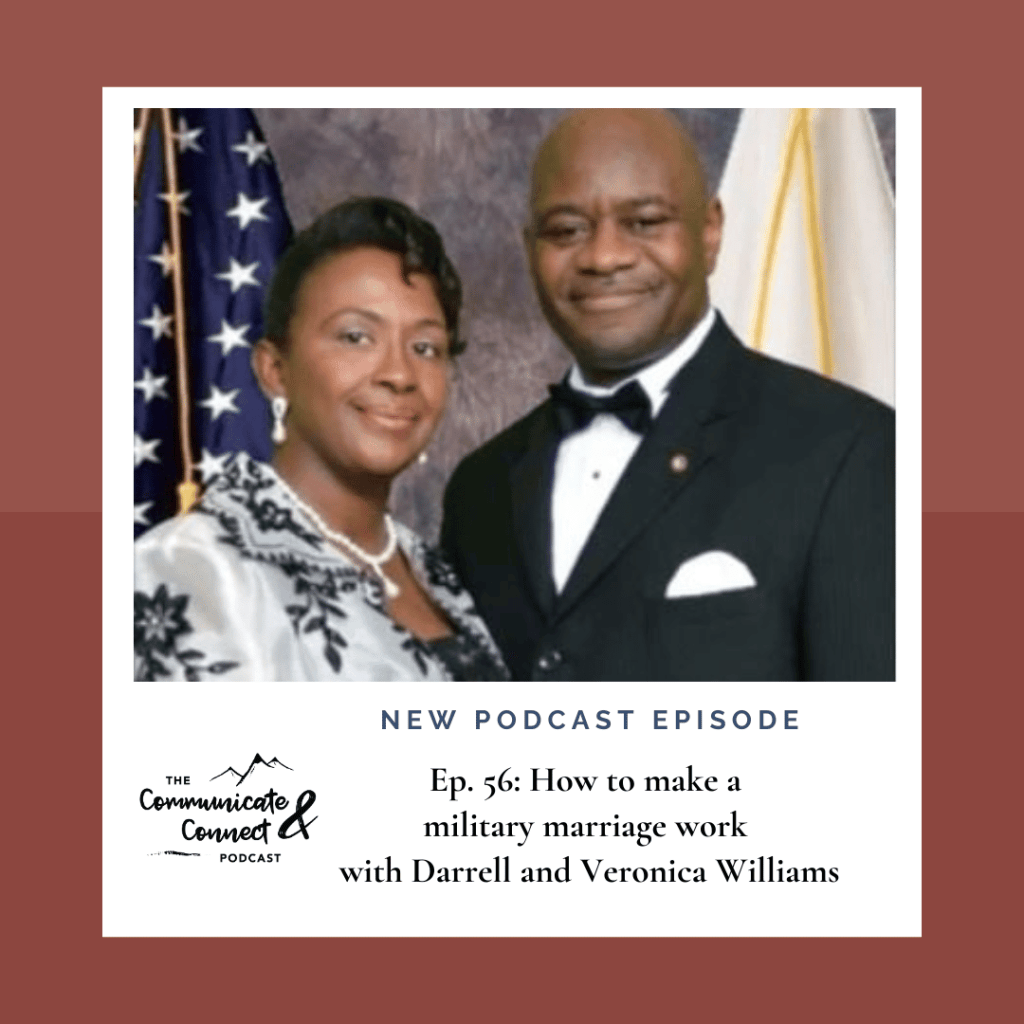
Darrell Williams, together with his wife Veronica, has celebrated 25 years of marriage. Both Darrell and Veronica hail from Compton, California, having shared the same middle and high schools, though they did not date during those years. Their relationship blossomed after their ten-year reunion, overcoming the challenges of a long-distance relationship. Darrell’s experience has lent him a unique perspective on navigating serious conversations and building deep connections in relationships, making him and Veronica well-versed in moving beyond surface-level interactions to truly understanding each other. Check out their coaching website here.
Free Relationship Pattern Assessment
Many couples assume they have a communication problem when they’re actually stuck in a relationship pattern that keeps creating the same conflict.
Take the free Relationship Pattern Assessment to discover what pattern may be keeping you stuck and learn what to focus on next.
👉 https://pages.communicateandconnect.com/relationship-quiz
Episode Transcript for “How to make a military marriage work with Darrell and Veronica Williams”
Dr. Elizabeth Polinsky [00:00:01]:
This podcast is sponsored by Communicate and Connect Counseling, where we have a team of therapists who provide individual, couples, and family therapy services, all tailored to meet the needs of military and veteran families. To learn more about our services, visit www.communicateandconnect.com.
You’re listening to episode 56, how to make a military marriage work with Darrell and Veronica Williams. All right. Welcome back to the Communicate and Connect podcast. I am pretty excited. We have a guest on our podcast today, Darryl and Veronica Williams, and they were a military couple, are a veteran couple now, and so I’m so excited to have them tell us how to really make military marriages work and navigate through military life together. So, would you guys mind just telling us a little bit about the two of you?
Darrell Williams [00:01:21]:
Sure. Darrell and Veronica Williams been married for 25 years. It’ll be 26 years on September 5. Interesting fact about us is we both grew up in Compton, California. I went to the same middle school and high school didn’t date, but we had similar friends and hung around the same circles. And for us, our interesting thing was we had a long distance relationship that started after our ten year reunion. So being able to navigate that and talk to couples about serious questions and really getting to know each other, you know, we have that type of background and experience to get past, as we call the surface talk. And you get to the thing, you get to really know each other.
Darrell Williams [00:02:06]:
And it was just really interesting as we’ll get more into the questions about, you know, how we end up coming together.
Dr. Elizabeth Polinsky [00:02:14]:
Yeah. Yeah. Do you want to add anything, Veronica?
Veronica Williams [00:02:19]:
No, I think that’s a.
Dr. Elizabeth Polinsky [00:02:21]:
That’s pretty good. Yeah. Yeah.
Veronica Williams [00:02:24]:
Well, yeah, I would just say that how our friendship, you know, really developed into getting to really know each other, as Jerrel said, from surface talk to really deep conversations that were within boundaries as to what single people should be talking about and discussing at that point, and then that leading us to realizing that there was more than just being about friends between us.
Dr. Elizabeth Polinsky [00:02:52]:
Yeah, I think you said that you guys were long distance, and I know so many military couples who are dating who are long distance, but even after they’re married, having periods of long distance. And I could see how you would really need to somehow get to those deep conversations kind of quickly because it’s so hard to stay close and kind of connected when there’s all of that, you know, I can’t see you and hug you or go on a walk with you. Was there anything that helped you guys be able to have those sort of deep conversations?
Darrell Williams [00:03:38]:
Great question. I think one thing that helped was we were boats, you know, in our thirties when we got married. So we are pretty much went past all of the thing of kind of getting to know who you are and your career was already established. So I think for us, and like Ron could say, our faith really was helpful because first of all, we were friends, so it’s like I always wanted the best for her anyway, just as a friend. And then with the faith part, it’s kind of like you have that goal of, hey, where do you see, you know, yourself doing in the future? What are those type of values? So we were already aligned that way. And like I said, we came together. I was working with teenagers, she was working with children in the ministry. So knowing that we already had kind of that background of helping others.
Darrell Williams [00:04:29]:
Right. Whether going to be a conflict, it’s going to be one that we actually completed each other because we already had that similar interest.
Veronica Williams [00:04:39]:
And I think one of the key things about when you meet someone that has the same faith as you and that they’re just not attending church, but they have the deep relationship that you have with. For us, we’re christians, so that we have with Christ, you want that person to really have a relationship versus just coming to because the other person, that’s the other person’s desires or wishes, but you want to be there because it’s after the marriage where you decide that you cannot keep up with that expectation that that person has on the type of person that they wanted to meet. But I think in being in a friendship, we already knew what each other was like when we serve God and when we served our church and how we participated. So that made it easy for us. However, we do see that, that being a very critical piece for those that do have some type of faith where they’re committed to a church organization, and you really want to make sure that that individual has the same alignment of commitment as you do. And even if they are, and they’re on target for growing to that place, even if that’s not where you are. So that’s what I would like to add there.
Darrell Williams [00:06:06]:
And then for those that may not be faith based, we always say that their values should be aligned. Right. As long as your values are aligned and you have those similar long term goals, the relationship can still thrive that way as well.
Dr. Elizabeth Polinsky [00:06:22]:
Yeah, I really like that word, or like the word aligned that you guys keep saying, because I I can see how important that would be and how you guys had that. Like you were friends, so you already clicked. You know, your personalities meshed well enough together, and you were kind of aligned that way. Your, your faith and your level of investment in your faith was matched. And I think, and then I’m hearing also that youre a similar, I guess I think I’m going to call it a calling. I’m not really sure what exactly calling. Okay. That was aligned, too, because I’m thinking that there could be couples who are both, you know, they’re kind of aligned in their faith, but they may not be so aligned in their, where I’m going and what we’re doing and this is going to be our life together.
Veronica Williams [00:07:26]:
Yes, you’re exactly right. And I would say that when you find that you are aligned together in your faith or spiritually, you’re more of that support for that person and you’re not in a competition with them and that, you know, that’s what’s going to build your relationship a lot stronger and be a foundation for you to have that stick to it, to stay together, to want to be together and be each other’s best friend, realizing that, okay, where we’re going, you’re not my enemy. You know, we’re each other’s support. We’re each other’s help. Wow. For us, we felt like, you know, we were both at a place where we just wanted to be friends. Right. We were at friends.
Veronica Williams [00:08:14]:
Cause he lives on one coast, I lived on the other. And it was really far from our mind, but probably in our personal prayer time, not telling one another. We were seeking God as to where the direction he was leading us because of service in our churches. And so, and now we were getting older and we were wondering the direction that God was taking us as to whether he was going to bring us a helpmate. Right. And so just becoming friends, getting to know each other is how it spun upon us that, well, I like to say that Darrell, he courted me. You know, that was one of the things I mentioned to him. I said, you know, I don’t, you know, as we’re going to try to take this law different, in a different direction and we are going to be long distance, you really are going to have to court me.
Veronica Williams [00:09:11]:
I know that it’s such a taboo word, but we established ground, a foundation as to what did that mean for each of us and where did we plan for this to take us to, you know, because they’re out. During the time we were dating, you know, there was so many, I think, guidelines or rules that people placed on each other. The unrealistic expectations.
Dr. Elizabeth Polinsky [00:09:35]:
Oh, yes.
Veronica Williams [00:09:37]:
Say if your friend went through it and they tell you about their situation, you’d be on alert for it. Right. But not all relationships are go out in the same direction and are set and based on the same foundation. And that was something to learn and something to share with others that had a new revelation based on observing us from our dating perspective.
Dr. Elizabeth Polinsky [00:10:02]:
Yeah, I really like that phrase of expectations. Unrealistic expectations really stands out to me because when you said that, I started thinking about, you know, I’m in all of these different military spouse Facebook groups, and I’m just remembering one where somebody kind of ranted and raved about how their partner wasn’t responding fast enough to emails while their person, while they were deployed. And I was like, oh, gosh, that feels like an unrealistic expectation. I see you nodding your head. So im glad im not alone in that. And it would be hard because I think that if they were not deployed, I could maybe have some expectations that my partner would respond in a timely ish manner. But what is realistic seems to be very different, at least if someone is stateside and available compared to deployment and, and lots of different. It just feels a little bit different sometimes for military versus maybe what would be more nor the norm for a civilian couple.
Dr. Elizabeth Polinsky [00:11:28]:
So I guess I’m wondering if you could tell us a little bit about any of the things that you guys found kind of challenging about military life together and I, and how you sort of navigated that. I’m hearing friendship was a big part, faith was probably a big part.
Veronica Williams [00:11:50]:
And trust, you know, you have to build up trust because I think with any relationship, I think a lot of people put up boundaries or that unrealistic expectation based on their past and based on what they might have experienced in life through observation and witnessing others, especially when it came to military. And so you had to have that deep conversation with your particular spouse so that you can hash out or, you know, discuss some of the things that you’re expecting that may not be met, they’re not, and is it gonna be a deal breaker? But basically, you know, getting already preparing for the disappointment because we can expect something off of someone, of someone, but that is not something that is of a priority to them. So it takes having that conversation to talk about it. Like, is this realistic if this happens or if that happens, such as, like you say, is it realistic that when you’re, you know, away off, you know, on an assignment and I text you and we might be in a different time zone, is it realistic for me to expect you to respond back in five minutes. Even when we’re stateside. Can you. Can we do that? So you have to understand what parameters to put those realistic expectations on, but you have to also have your own personal experiences and scenarios that you go through.
Darrell Williams [00:13:26]:
And I think the other thing for me was, since she was not in the military, I wanted to make sure that she knew what she was getting into. So one of the things I did while we were dating was, well, once we knew that we were going to get married, about her, it was like a military spouse book, like, everything that a military spouse should know. And I thought it was such a good book because I wanted her to know everything. Right. And then when we were talking later on that week, if she had any questions, you can always, hey, what did they mean by this? And what is that? And that turned out to be some really good discussion point because I wanted to make sure it was kind of weird, almost like, man, are you trying to scare her away? But it really wasn’t the case. I just wanted to be so upfront because although I was not in a deployable unit, the agency that I was in, we traveled just like we were deployed on a different day. There was a lot of smaller times of leaving versus being gone for a month, two months, or six months, but it was like week at a time, back for a couple of days and maybe out for two weeks and back then out for three weeks. So even something like that, I wanted to make sure that I was able to answer any question that she had on, you know, that she was okay with that type of lifestyle.
Darrell Williams [00:14:45]:
And we talked through, what are some of the things that we can do during that time where I think sometimes it’s a military couple, like, well, we’ll figure that out when we get to it. Like, no, you really want to kind of talk those things out?
Veronica Williams [00:14:58]:
Yes. And it was a very helpful book because I knew about the military through some friends and family members that were married to military spouses, and I wanted my outcome and my results to be different. And I also wanted to make sure that it was going to be realistic for me because it was going to require me to move away from my family, which I was very close knit with. So almost every day talked to every day, and now adjusting to it, to a lifestyle that was going to move me away. I may not see them as frequently as I want or as I did growing up, but having those discussions with Darrell, knowing our family backgrounds, is very key in any relationship and realizing what expectations family may have and potentially their role in your relationship. So that was important for us. And having that book helped navigate me through the processes of military life and what is some of the things we may not experience, but then putting them relative to what we will experience, which is what made that a lot more practical to handle and talk about.
Dr. Elizabeth Polinsky [00:16:18]:
Yeah, I’m hearing there was so much like intentionality for you both every sort of step of the way and a lot of sort of forward thinking about the future and how do we, how do we plan for it in advance and be as prepared as possible in.
Veronica Williams [00:16:38]:
Advance and, you know, prepare to stay together and not be, not let our military life get in the way at some point when I did move here. And so learning how we, like we tell the couples that we talk to is that our goal is to stay together and allow our marriage to thrive and nurture it in the areas that need to grow and mature or be dealt with. That seems a little bit uncomfortable.
Dr. Elizabeth Polinsky [00:17:11]:
Yeah. I’m just thinking right now of people who might be listening to this and I’m just imagining someone’s going to want that book. Do you happen to remember or know what it was called?
Darrell Williams [00:17:25]:
Wow, that was a long ago. I do not know, but I’m sure they’re probably in the 15th edition of it by now. But I’m sure if they go to any clothing sales or go online, they’ll be able to find it. Basically a military spouse book. Everything about being a military spouse. And I know it was helpful back then, so I’m sure it’s even more helpful now because it was just a great tool. And again, they’re worried about being intentional. I wanted her to be as comfortable as possible.
Darrell Williams [00:17:52]:
I wanted her to know exactly, you know, this is what it’s like to be a military spouse. These are some examples of, and I know that listening to one of the other podcasts, you know, you mentioned that you love a good love story, so.
Dr. Elizabeth Polinsky [00:18:05]:
Yeah, I do.
Darrell Williams [00:18:07]:
Sure.
Veronica Williams [00:18:07]:
One thing, I was just going to talk about the book, just to say that it was a helpful book. I don’t have mine anymore. I’ve passed it on to two people already many years ago, and I don’t even know whose hands is in now. But it was very helpful for anyone that is marrying a military spouse. I think they even have it where it’s even for if there was a male spouse marrying a military, military female spouse. So it’s out there. And I think it’s a very helpful tool, especially when you’re getting into something that you’re not aware of or that you need to know what you’re getting into. I think that.
Veronica Williams [00:18:46]:
And that helped take away a lot of any anxieties or fears and not so much that, but unexpectedly.
Dr. Elizabeth Polinsky [00:18:56]:
Yeah. And I think. I guess I’m thinking of also anger and sort of frustration. Some of the people that I have heard who will say, like, I wasn’t prepared for this. There’s so much kind of anger and frustration of I didn’t have a fully informed idea when I made my choice. So I think that is probably really, really important is for people to have an idea of what they’re getting into with military life.
Veronica Williams [00:19:34]:
Yep. And part of that is the responsibility of the military spouse to ensure that that individual is going to know what is expected. And that’s on all levels of ranks, especially if there’s a leader role. And even if your spouse is on the leadership path, learning all of those demands that are, there are the expectations that go along with it so that you can be a support and understand the process. For some, it’s not as easy. But for me, I didn’t find it too hard because of the book and the level of conversation that we were that we had about what it was going to be like marrying someone with a military background.
Dr. Elizabeth Polinsky [00:20:30]:
Yeah. I think that is amazing that you guys had that. And I am thinking if this was, I’d want to highlight that. I have this picture of, like a highlighter in my mind. Yeah. And so I think you. I think I was about to hear about a love story. Can I still hear about that? Because I do really love love stories.
Darrell Williams [00:20:53]:
Sure. Because actually ties into what Veronica was saying about preparing the other person. So when I was dating Veronica off with the White House communications agency. Right. Which is an agency that supports the president, vice president, first lady, saw a lot of travel involved. Right. So already knowing that not only was she going to come into this military lifestyle, but she’s also coming to this lifestyle where we’re traveling just as much as deployed units. Right.
Darrell Williams [00:21:21]:
Like a second airborne 101st. Like our agency, it’s nonstop when it comes to traveling. So the cool part about that was when I was, as we’re going toward our tenure reunion, I was doing a lot of trips to California. At that time, President Clinton was in office, and he loved going to California. And a lot of people didn’t like to do the west coast trips because it was the five hour flight and the three hour time difference. So I got all of those trips, which is really great. So as we were leading up to our tenure reunion, I was doing all those trips, and it was almost like, we were having these mini reunions before the real reunion, and every time I would get ready to come, oh, we’re going to invite so and so. Are we going to invite so and so? And then when Veronica’s name came out, like, oh, yeah, I remember her.
Darrell Williams [00:22:06]:
She was, like, really smart back then, and. But she could never make it because she had a lot of things going on with her family and with her church. So one of the times I reached out to her, like, hey, I know you couldn’t make it. Well, I got an information from a friend. First of all, they said it was okay to get her information. And then I invited out to lunch while I was out there, tdye and, you know, public place, want to make sure she felt comfortable because she knew me ten years ago, didn’t know what type of person I was now, so I wanted to make sure I was on my best behavior, right? And again, that’s when the friendship kind of started. And then months later, we went to the reunion. Really kind of, like, connected.
Darrell Williams [00:22:52]:
And then after that, I was telling my roommates, like, man, no, she’s really, really nice. I mean, she’s doing all these things for a church. She’s there for a mom and daddy. And I never forget, my friend was like, what if she’s the one? And I’m like, the one? What? Because I totally didn’t think about it as anything deeper because at that time, I knew I was going to Korea. So my mind, as a friend, it’s like, I would not dare ask her to wait for me for a year, right? So it was like, no, I’m not going to do that. But the closer we got to the time, I was like, I think she is the one. And I. Our conversations kind of went from vaguely talking about relationships to if I was to ask you to marry me on the scale, where that scale at, you know? So I wanted to get a good comfort, because what I ended up doing was I bought the ring because I was supposed to go out of St.
Darrell Williams [00:23:46]:
Louis to go to Korea. But I found out that I could go out of Seattle. And toward the end of my first part of being at the Washington agency, I was on the recruiting trips and talking about Hallmark moments. The last trip that I went on was in Seattle. I knew the hotel. It was close to the airport and all that. And I had bought the ring, had intentions to propose to her, but she didn’t know that. And so I said, hey, I’m flying out of Seattle.
Darrell Williams [00:24:19]:
Do you mind coming to visit for the weekend? We can have separate rooms and. No, maybe just get to know each other. And she was like, okay, you know, and me being the planner that I am, right? So I went to the bar, I mean, the restaurant before. It’s like, hey, you don’t remember me, but I was here on a recruiting trip. Like, oh, yeah. Remember you guys? Y’all were great. And I said, hey, I’m going to propose to my fiance or my girlfriend tonight. I want to know, like, is there a particular area I can sit in? Because I know when we’re here.
Darrell Williams [00:24:49]:
We enjoyed the restaurant and the way this restaurant was set up, they had a real nice booth that sat above the rest of the floor. So if you sat there, people can’t help but to see you.
Dr. Elizabeth Polinsky [00:25:01]:
So I’m on display.
Darrell Williams [00:25:03]:
On display. Which is kind of challenging because, you know, again, she’s kind of to herself and quiet, and I’m kind of like, I don’t care if the world knows type of situation. And I forget. I talked to my guy, James. He was our God. I was going to be on duty. I said, I said, james, I’m going to. I already know what’s going to happen, right? We’re going to order food, enjoy our dinner, and then I’m going to order two desserts.
Darrell Williams [00:25:27]:
She’s not going to want one, right? But I want you to bring it anyway. And I want you to put the ring in her dessert thing because it was both covered up. And he was like, oh, this is great. We’re going to do it. No problem. Looking forward to it. So fast forward. She comes in, I pick her up, kind of have a small talk, get to know each other a little bit more, catch up.
Darrell Williams [00:25:50]:
Then we go out to dinner that night. So I go and like, hey, two for Williams. And he’s like, you know, sure, you can have the seat in the middle of the restaurant. So we get up there and dinner’s going great. We’re talking, and then it’s time for dessert. I’m like, hey, you want dessert? And she’s like, no, fine. And I’m like, no problem. I like to have apple pie.
Darrell Williams [00:26:13]:
And James asked her. And she was like, nope, I’m good. So then he brings two dessert dishes covered up, and Veronica’s like, oh, excuse me, I didn’t order the. No, James brought the dessert. And he goes, here’s your pie. Like, okay, I can’t wait to see how this is going to happen. And she’s like, oh, no, no. I didn’t order it.
Darrell Williams [00:26:37]:
I thought, it’s okay. I’ll eat it. So before I open up the pie, started talking to her, like, you know what? This has been, like so much fun. Getting to know who you are, getting to know you and all that. And, you know, me being in the military, I wrote out my whole thing, what I was going to say. So I practiced it a little bit, but I wasn’t going to mess it up. So once I got to the middle part of it that was deep, I got on one knee and told her basically, you know, to the fact of, you know, have so much fun up to this point, why wouldn’t I want to have more fun for a lifetime and just wanted to know when you marry me? So I opened up the second dessert tray, and James, right on point, had the ring sitting there inside the box, ready to go. But what I didn’t expect was for her to hyperventilate because of.
Darrell Williams [00:27:30]:
So now I’m getting a little nervous because I’m like, oh, my God. She’s like, I only saw this on tv. I never saw anybody do this before. So the restaurant was so great. They brought her a paper bag. She was able to, you know, get calm again. And, you know, me being in the military, it’s like, okay. Once she’s okay, it’s like.
Darrell Williams [00:27:49]:
And the answer is. And then she said yes. And it was so funny because it’s like the whole restaurant was like, oh, my God, somebody’s proposing. So it was truly like one of those hallmark moments that, like, you couldn’t have planned it any better. And my guy James, I’m always gonna be forever indebted to him. Cause he was just right on point with everything. No mistakes at all. It was so much fun.
Dr. Elizabeth Polinsky [00:28:19]:
It does sound like a Hallmark movie. And you’ve got the little twist in there with the hyperventilating, and you don’t have the answer. Yeah.
Veronica Williams [00:28:28]:
And mind you, I couldn’t even answer right away if I wanted to, because the people on top that were looking down and they were all clapping.
Dr. Elizabeth Polinsky [00:28:38]:
So much pressure, right, to have. I mean, I know you guys had talked about it, and there was some, like, gauging of her answer before.
Darrell Williams [00:28:46]:
Definitely gauging. I’m not gonna lie. I was definitely gauging.
Veronica Williams [00:28:49]:
Yeah, I definitely was not expecting that. I totally wasn’t really expecting that at all. I thought maybe, you know, it might happen down the line if that was the case. Because one of the things about him going over to Korea for a year, you know, we had talked about it, and I had said that, you know, he was saying that he didn’t want me to wait. And I said, and I don’t. If you go over, you meet someone else. I don’t want you to either, because it’s all. It’s not just those of the korean racial group.
Veronica Williams [00:29:22]:
There’s also american soldiers that are over there, men and women. So if he was going over there to meet, that was fine, because things happen, you know, because how it works for me is that it’s probably. Probably when you least expect it. And I think this was a situation that, when I least expected it, of course, we always had long winded conversations. We had a lot of talk, and we had a lot of fun. We laughed. We enjoyed each other’s company. But that was definitely a surprise to be remembered.
Veronica Williams [00:29:54]:
That was really a highlight of our life together.
Dr. Elizabeth Polinsky [00:30:00]:
Yeah.
Darrell Williams [00:30:01]:
Then a part two of that was. Besides the book was being in Korea allowed me to do the courting, which was great. So people have to realize, this is before the Internet got really big. It was still early into that. So I’m sending her cards. I’m spraying cologne on the cards. I’m sending little gifts and teddy bear. Then those that might not know, I will send her little cassette tapes with different love songs on it.
Darrell Williams [00:30:28]:
And, I mean, I took the cordon thing all the way to the max. I think it was a lot of fun doing that because it showed her, like, this is just how much I care about you. And then the other preparation part, we got to the part where I was going to be there over a Thanksgiving time frame. So I had invited her to come to Korea during thanksgiving, because part of me was, even though I was going to back to white communication agency, it wasn’t going to be the same as a real military based. But I just thought, man, what a great opportunity for her to see the far end of what that would look like. So for her go to Korea, staying at Dragon Hill Lodge and, you know, seeing tanks going down the street and all that, it was like, it really painted that picture, because, again, I just really wanted her as a friend to know that this is worst case, typical military. I’m not going to be in that situation. However, the stakes are still the same.
Dr. Elizabeth Polinsky [00:31:27]:
Yes. That is such a unique experience, I think, to be able to sort of see what it’s like. I’m thinking I had some exposure because my mom ended up getting out, but my dad stayed in. And when he would deploy, he’d send postcards of. Of the ships and things, like photos. And then I grew up in an army town, and so I got to see things. And, of course, when I met my, I guess, you know, now husband, but he would, like, show me around. But it was all, you know, it was all in the US in the middle of a city where I could go to the Starbucks down the street.
Dr. Elizabeth Polinsky [00:32:18]:
So that is such a unique thing to get a feel for what it would be like. I know one of the. We’re, like, a year and a half away from wherever we go next, and so we don’t know where we’re going next, but one option is to Japan. It’s hard to think what would life be like? And I. So, wow, what a unique thing that you got to do to try to feel prepared.
Veronica Williams [00:32:50]:
Yes. And it was very. I don’t know. I can’t even describe it because I couldn’t. Of course, I didn’t go off base by myself when I went with Darrell, but I had to make sure I had my passport with me. You know, when you think about the tv shows with the military at the gate, with the guns and really, and I’m talking about the foreign movies with the military, it was just that setup. It was unlike being a civilian living in, you know, stateside without military being around. Military bases were around me, but they were isolated, and they wasn’t so blended in with the civilian life as much in the area where I grew up.
Veronica Williams [00:33:36]:
So it was quite different. It was quite like, wow, is it gonna really be like that when we move to the actual place, you know, that he’s gonna be stationed at when he gets out? But it also enlightened me to realize and going during that, I think I went for a whole week. Going for that time allowed me to see his military role in his unit, and it allowed me to see him in his leadership role. And that was what was compelling to see and knowing, like, you know, it’s not just going to be here in Korea, but it’s going to be somewhat similar but a different capacity, even when it went back to the White House communication agency. And so I think that made it softer, because the tenseness that I saw there in Korea was different from what I saw here when we went to the White House communication agency or when he went back there. So it made it a lot easier and circumstances that said, oh, I can handle this because this is totally different from what I experienced in Korea. But it wasn’t something to reject or pull away from. You just saw what the military is really like not only in the United States, but in a foreign land and how the countries are really protected.
Veronica Williams [00:35:04]:
So it really showed me a frontline glimpse of the military. I had brothers that was in Vietnam, but nothing like this. They didn’t remain there, so. And they were drafted. Not. It wasn’t something that was voluntary. And so it was quite an experience. But I think having the military spousal book as well, along with going to visit, that made it more helpful, because then I also had the book with me, and I was like, you know what? I talked about this piece here.
Veronica Williams [00:35:41]:
Now, we just went there. How is that related a little bit more to our reality when you leave here? And so I thought that was very. Not only to read it in a book, but to also experience it. It was quite an experience that, you know, you can’t really describe it because you’re in that moment. How we respond to the military in the United States is so different than other countries and the extensiveness of it. So I really saw how being in the military on a military base was so different from the freedom that you have living as a civilian stateside.
Dr. Elizabeth Polinsky [00:36:23]:
Yeah, yeah. And what life might look like as a military couple, being maybe way more restrictive if you were living in a. In a different country compared to if you’re stateside.
Veronica Williams [00:36:41]:
Yes.
Dr. Elizabeth Polinsky [00:36:44]:
One of the things that I wanted to ask you guys about was, you said you’ve been together 25 years. It’s going to be 26 soon, which is amazing. And I am really hoping me and my husband, you know, I’m hoping we outshoot you, maybe.
Darrell Williams [00:37:04]:
Absolutely.
Dr. Elizabeth Polinsky [00:37:06]:
But I’m thinking, like, is there anything that you did on a day to day basis or, like, a weekly basis or somehow. I think there are these researchers called John and Julie Gottman, and they talk about couples having rituals of ways of staying connected. Was there anything that you guys kind of made a part of your life as a way to help your marriage through the years and just life, but also through the military?
Darrell Williams [00:37:41]:
Sure. Like, we tell a lot of the couples. We really just kept it simple. I mean, the biggest thing I always tell people is, she was my best friend, okay? Why would I do anything to hurt my best friend? That was always the mindset. So she’s my best friend, and she has goals, and guess what? Hey, what are your goals? Right? What do you. What do you want to do? What would you like to do? All right. Because I just felt, with all my military backgrounds, like, I can take care of myself in my career and help her with whatever direction she wants to go in. Right.
Darrell Williams [00:38:13]:
I want to be her biggest cheerleader, her biggest fan, so. Cause, you know, military spouse member, they always say you know, I couldn’t do anything without my spouse. So my thing was I wanted to live that instead of just saying it, wanted to live it in front of her. So for me, it was just being her best friend. Right. It’s like, you know, what does she need to do for her to grow? And I was other thing, too. In my mind, it wasn’t just my career, but it was also, what does she want to do? And then how can I help move her in that direction? And if she changed directions, hey, no problem. What do we need to do next? Right.
Darrell Williams [00:38:48]:
How do we maneuver through that? And I think that helped us from a lot of different areas, one, not just in her regular civilian life, but even in ministry. Like, if I knew she was going to be working with women, well, what can I do? You want me to team up with the husbands? You know, just tell me what I need to do. You may just be a chauffeur and drop you off at meetings and go back and pick you up. So one of the things I love, when we went to our marriage counseling, Pastor Hay had us fill out the information, and we couldn’t see each other’s answers. And then we had to come meet with him, and he went over it, and it was really good to hear that positive note that he said basically was, I don’t see anything on here that’s a red flag that would keep you all from getting married and thriving in marriage. Right. But one thing he shared with me was the, Darrell, I’m going to give you one thing to do. If you do this one thing, I think you’ll find it very helpful in your marriage.
Darrell Williams [00:39:49]:
So I’m no military minded. I’m ready to take notes and write all this stuff down. And all he said, liz, was, your job in this marriage is to help Veronica find her purpose. Then once she finds her purpose, your job is to help her fulfill it. Best advice I could have gotten, because what he was telling me was, when you’re helping her, by focusing on her, she’s automatically going to help you and focus on you. And that’s exactly what happened over these 25 years. Whatever direction I went in, whatever direction she went in, we were each other’s cheerleader, and whatever that faith of our life was.
Dr. Elizabeth Polinsky [00:40:36]:
Yeah.
Veronica Williams [00:40:37]:
And it’s reciprocal. You know, when you give to the other person without expecting anything back, it’s automatically going to be given to you. And so we supported that. There was times when, you know, he was studying for military boards.
Darrell Williams [00:40:53]:
Yes.
Veronica Williams [00:40:53]:
And I would be up, I might be sleepy because he may not have had to go to work the next day, or maybe he did, or he’s about to travel. I would be up and I would be answering, asking the questions. So he’s preparing because we got this thing. You got the military board tomorrow. So I’m spending hours doing that to make sure that he had the right answers that he wanted to provide when he was examined, you know, the next day. But we would study. When he was studying for weeks, I was right there studying with him for weeks. So we were just each other’s support, you know, you just got to make sure that the individual that, you know, in all of that, we felt that not only did we feel when God tapped us both on our shoulder and say, hey, it’s fine.
Veronica Williams [00:41:41]:
I want the two of you to be together, we felt that it was a calling from a spiritual standpoint, that God said, it’s okay because, you know, you can get comfortable being single and realizing that, oh, I’m just gonna stay single. People come in our life, and we don’t think that it’s gonna be anything different, you know? But God wanted us to have an open heart as to why we were spending time together, why we were doing the things that we were doing. It wasn’t just to be doing it, but God’s plan was that he would make us a holy hookup and that we would become what he wanted us to be, not who we wanted each other to be, but that together, we became who God wanted us to be. Because once we said, I do, we were one. And I think God showed us how. How we were separately as individuals, but then how we were collectively as a couple and the role that we had together in serving God and living the life for him and hearing his voice and telling us when to move. It was almost like God said, move, you gotta move. It probably sometimes was a little scary for us because it took us out of our comfort zone in some stages of that over the 25 years.
Veronica Williams [00:43:01]:
But when we finally said yes, we realized it was easy, and it was easy to move forward and in step with one another.
Darrell Williams [00:43:11]:
And I think another thing that helped me also was having a mentor, right? So I always had mentors from my leadership part, but then also looked for leaders that weren’t just mentored for my career, but also for my relationship. Like, I looked at both individuals that had high rank and were married for a long time, and I would talk to them and like, hey, you know, what do you do to make sure that the job doesn’t get in the way, right? What did you do to make sure you still had that love and that passion and the advice that they shared? They willingly shared it. Like, they wanted to have somebody else come behind them, to have not just success in military, but also success with the family. And I just love that. The common theme that I got from each of those different mentors was, hey, this military stuff is going to go away. Only thing you’re going to have left when it’s all over is your family. So, yes, prioritize your work, but never let that be a higher priority than your family. And they showed me how to do that.
Darrell Williams [00:44:15]:
Right? Like, when we were going on different trips, TDy, we would come back, like, they would tell me, you know, don’t get so caught up on the trying to prepare yourself for the next gdy. Go home, disengage. Right. Spend time with your wife, go on a date. Right. Like, I mean, they made it, like, be purposeful about the time that y’all spend together. And having those mentors for my relationship were very helpful during my time in.
Veronica Williams [00:44:45]:
The military and for me, creating a village of women that were military spouses. And then I also had women that were in the military, but once they got married and had the children, they got out. So that was even that transition piece of it. So having really good friends, that helped me in that way. And then I think for us, which we tell couples today, we found a really good couple to help mentor us through some of our challenges.
Darrell Williams [00:45:19]:
We had.
Veronica Williams [00:45:21]:
I think that was very important and that we both were willing to realize, hey, it’s okay for us to get a mentor couple that can help us, you know, you know, we can do it individually or collectively. And then we had our, we had our accountability partners. You have your friends that really hold you to be true to yourself, true to who God wants you to be. And so I like to call those accountability partners, and I still have them today. They may change over years as you grow and mature and have different changes go on in life, but always keeping an accountability partner and always as a couple, having a mentor couple to help you navigate through things, and it doesn’t even mean that you’re going through challenges. It’s just someone to just be the sound of sounding bored and listening. Hey, did I respond appropriately? I have a situation going on, and I need to kind of talk about it, but I don’t want it to be something that is not going to be healthy. And so that was it.
Veronica Williams [00:46:27]:
And that was one of the key things is that we wanted to based on our backgrounds. We wanted to have a healthy background, especially when it was going to come to us deciding to have children. And so we wanted to be different. We wanted to find out from what was your background like with your family, what was mine like now? What were some of the good things that we can bring into ours and what are some of the things we can cast aside and don’t need to bring in. So we basically did not want to bring in baggage. You know, life itself is already hard. And you hear people talk about that all the time and you always hear people say, like, marriage is challenging. And so we took the approach of how do we take that negative connotation of it out and really thrive, especially with the faith background that we have.
Veronica Williams [00:47:19]:
How will we not make our life be a hypocrisy or be counterproductive as to the God that we serve? How do we make him be real, not just to us, but real to other people to have hope?
Dr. Elizabeth Polinsky [00:47:37]:
Yeah. There’s so much that, so much that I’m, like, pulling from what you both are sharing. I’m going to try to see if I can do a summary. Keep it. I don’t know. I like summaries. They keep my brain together. So I’m hearing there was an internal stance of I’m going to be focused on supporting my partner and looking out for their best interest and helping them pursue and go after the things that they’re meant to in life at an individual level, not just from our couple relationship.
Dr. Elizabeth Polinsky [00:48:17]:
I’m hearing that again. You guys have that same intentionality that you talked about before in even, like, planning around parenting with what did we like? What do we not like? How do we want to be together and getting. That’s like a very clear communication piece as well because you’re getting on the same page together and making the decisions and the choices together versus kind of like, somehow it happens. And then the mentorship piece is really. Yeah. There’s a. Some intentionality with mentors, like, who are people that I respect who are doing this the way that I want to do it, who have kind of gone the path ahead of me and can help us do this both as a couple and individually, and then also having a great set of peers who are going to be and friends who will be there to support you. I’m just thinking, like, sometimes I have clients that tell me like, hey, we can’t talk to our friends because it’ll make it worse.
Dr. Elizabeth Polinsky [00:49:34]:
It’ll be like more drama type of thing. But that’s not what I’m hearing from your guys story, it’s, we have these intentional friendships that are also friendships built around support and growth as well.
Darrell Williams [00:49:51]:
True. Great summary.
Veronica Williams [00:49:53]:
Yes.
Dr. Elizabeth Polinsky [00:49:54]:
Well, I’m just thinking about the time, and I know it is later for you guys where you are. Thanks. For me, do you have any final tips or words of wisdom for military couples or military spouses or military members who might be listening?
Darrell Williams [00:50:14]:
Sure. One thing I would tell the military members is they actually have, to me, an advantage over regular civilians because you already have this love of country and his love of serving. Right. Being a part of something that’s bigger than yourself, we would just challenge them to use that same mindset when it comes to their marriage. You know, always keep in mind that your marriage is bigger than you or the individual know that you should serve your spouse the way you’re serving your country and supporting your spouse who’s serving their country. And because the bond that we have as a military family is so special, because people that we used to meet, they found out that we were married, then they found out we were in the military, they were like, oh, my gosh, you guys must have such a special bond. I could never be married to somebody in the military. So it was almost like a visible badge of honor.
Darrell Williams [00:51:08]:
Like, only, are you in the military? But you guys are a strong military family. Right? So I want people to embrace that military family title because it does carry with it a lot of positivity. Right. And as long as you don’t try to do everything by yourself, you don’t try to, you know, imitate what you saw when you grew up. But like Veronica said, create in your own marriage what you want it to look like. It can be so much fun and so everlasting. And one thing we challenge couples to do is to find out what goal do you want for your marriage? And a lot of people say, well, what do you mean? We’re going to have kids. We’re going to get a nice house, right? It’s like, yeah, yeah.
Darrell Williams [00:51:51]:
But what do you want your marriage to represent, right? What do you want people to walk away with when they spend time with you? And once people started like, you know what? That’s a great question. Let’s go back and find out what do we want our marriage to be and do. It just turns on a different light bulb for a couple. So we just want to challenge them to, again, think about what do you, what’s the goal for your marriage? And how can people be inspired every time they spend time around you?
Dr. Elizabeth Polinsky [00:52:20]:
Yeah, I love that. I was just thinking, I’m gonna have to go ask my husband how he would answer that question. Yeah, well, I guess I want to make sure, Veronica, if you have anything you want to add, I want to make sure you get a chance to also.
Veronica Williams [00:52:36]:
I just ditto what Darrell said, because that is really the whole thing about it. And I just say, you know, free yourselves of unrealistic expectations. Become authentic. Be who you say that you. That’s a lot of things. Cause going into a marriage with someone with the military, they can have two sides sometimes, and two sides in that they’re there. And knowing how to balance that, because at work there, it’s all hardcore, and they don’t always know how to take the hat off and say, oh, I’m at home. I’m in a more relaxed environment.
Veronica Williams [00:53:21]:
And so learning how to have that balance and knowing how to handle that temperament, and it’s just that they’re goal driven, are hard workers, but learning how to do that and then build trust to allow the individual to be, you know, don’t have these weird things going on in your mind of assumptions. Talk about it. And that’s what I mean about the trust part. Just, you know, because there’s so much out there, the world has so many things. And deal with your relationship at face value as to who you’re married to and not who, and not based on something you heard or you’re comparing your spouse. Allow your spouse to grow into who they are and who into. For us, it was grow into who God wants you to be and not put extra burdens or pressure on the individual because they’re not meeting your expectations. But talk about what that expectation looked like for you and just build a solid foundation, a foundation that allows your marriage to stand with the both of your personalities, not on past history of family, friends, even some of the people around you.
Veronica Williams [00:54:55]:
But always have a network of accountability, partners and mentorship couples that can help you. And it may not just be one. It may be multiple people that can help you in various areas of your life. And I think from those key tools, you can have a successful marriage. And the fact that you ask someone to marry you or you respond, I do do it sincerely from the heart, and make sure that you really want to be married and that you really want to grow into what that role is, because there’s no set role. Every couple has a different role, and so it’s for the couple to set that foundation of their expectations for how each spouse will operate in their marriage.
Dr. Elizabeth Polinsky [00:55:46]:
Yeah, I love all of this there’s so much that I’m like, I want to have a quote of this, have a quote of that and put it different places. But I’m thinking about the mentorship piece because you guys do this together in a form of, like, coaching. Can you tell us a little bit about kind of the services that you offer to couples to help them?
Darrell Williams [00:56:17]:
Sure. So again, we’re givers automatically. So we’re like, you know, we’re not going to be married 25 years and not want to help other couples. So we started alliance seminars, coaching, right? Collaborating towards success. And we just use those time tested principles to help other couples regardless of premarital or maybe they’re already married. And I love how my wife said they may be having some hiccups, right? Hiccups can be solved, right, with certain type of strategies. So we just make ourselves available to help other couples because that’s what we always joke around when we were in Seattle, we were walking and we would see these older couples always holding hands. And we were like, that was the goal.
Darrell Williams [00:57:00]:
That was one of our first goals in our marriage. Like, we want to be them, you know, 15 years, 25, 50 years. Like, we want to be that older couple holding hands so somebody can see us and say we want to get there. So we just, again, started last seminars, coaching just to help other couples reach whatever the potential that they have for their particular relationship.
Dr. Elizabeth Polinsky [00:57:25]:
Okay, great. I will make sure that there are links in the show notes for anybody who wants, like, a quick way to just click and go to your website for the coaching. I just love that you’re doing that and that you’re doing that together and it’s something that you share and I think that’s so meaningful to be able to sort of have that mentorship from a couple who has walked the path ahead. Well, thank you so much for being on the podcast. I have really enjoyed it and I am really certain that so many people are going to get a lot of great things out of this episode.
Veronica Williams [00:58:12]:
Thank you, leah.
Darrell Williams [00:58:13]:
Yeah, thanks for having us.
Dr. Elizabeth Polinsky [00:58:25]:
I hope you enjoyed today’s episode. If so, please take a second to go rate, review and subscribe so you get all of our future episodes. Make sure to check out the show notes to sign up for our free ten week relationship email course this email course is really designed for people who are maybe having trouble with communication or connection in their relationship and helping them develop some quick wins right away to start, start improving it. While I am a therapist, this podcast is for educational purposes only and is not considered therapy. And it should also not be a replacement for therapy. If you think you need a professional of any kind, you should definitely go find one. Until next time.


