

Episode Outline: “Moral Injury with Dr. Wyatt Evans”
Episode Summary of “Moral Injury with Dr. Wyatt Evans”
Welcome to another enlightening episode of The Communicate & Connect Podcast, hosted by Dr. Elizabeth Polinsky. Today, we have an incredibly compelling discussion lined up about the intricate and often misunderstood topic of moral injury. Joining us is the esteemed Dr. Wyatt Evans, a board-certified clinical psychologist renowned for his work with the VA North Texas Healthcare System, as well as his research into moral injury and resilience.
In this episode titled “Moral Injury with Dr. Wyatt Evans,” we dive into how intense emotions like anger and moral pain can develop into moral injury, especially following deep betrayal within relationships. This nuanced conversation contrasts moral injury with PTSD, focusing on the former’s roots in contempt and trust issues, as opposed to fear responses central to PTSD.
Dr. Evans sheds light on Acceptance and Commitment Therapy (ACT) and other emerging therapies that show promise in addressing moral injury, particularly within military contexts. He shares powerful examples, including scenarios faced by service members that illustrate the profound moral conflicts they encounter. These insights pave the way for our discussion on “The Moral Injury Workbook,” co-authored by Dr. Evans, which offers a structured approach for sufferers and their partners to understand and heal from moral injury.
Dr. Polinsky and Dr. Evans also explore the real-life impact of moral injuries in non-military settings, such as relationship violence, emphasizing how guilt, shame, and betrayal can signify that one’s moral values remain intact despite intense pain.
Finally, we’ll highlight the importance of maintaining connections and realigning actions with one’s values as critical steps in the healing process. Remember, this podcast aims to educate and inspire, serving as a complement to, but not a substitute for, professional therapy.
Don’t miss this thought-provoking deep dive into moral injury. And as always, if you find value in our podcast, please take a moment to rate, review, and subscribe. Stay tuned for another episode designed to help you communicate and connect like never before.
Don’t forget to check out our free 10-week relationship email course! Let’s get started!
Guest Speaker Bio – “Dr. Wyatt Evans”
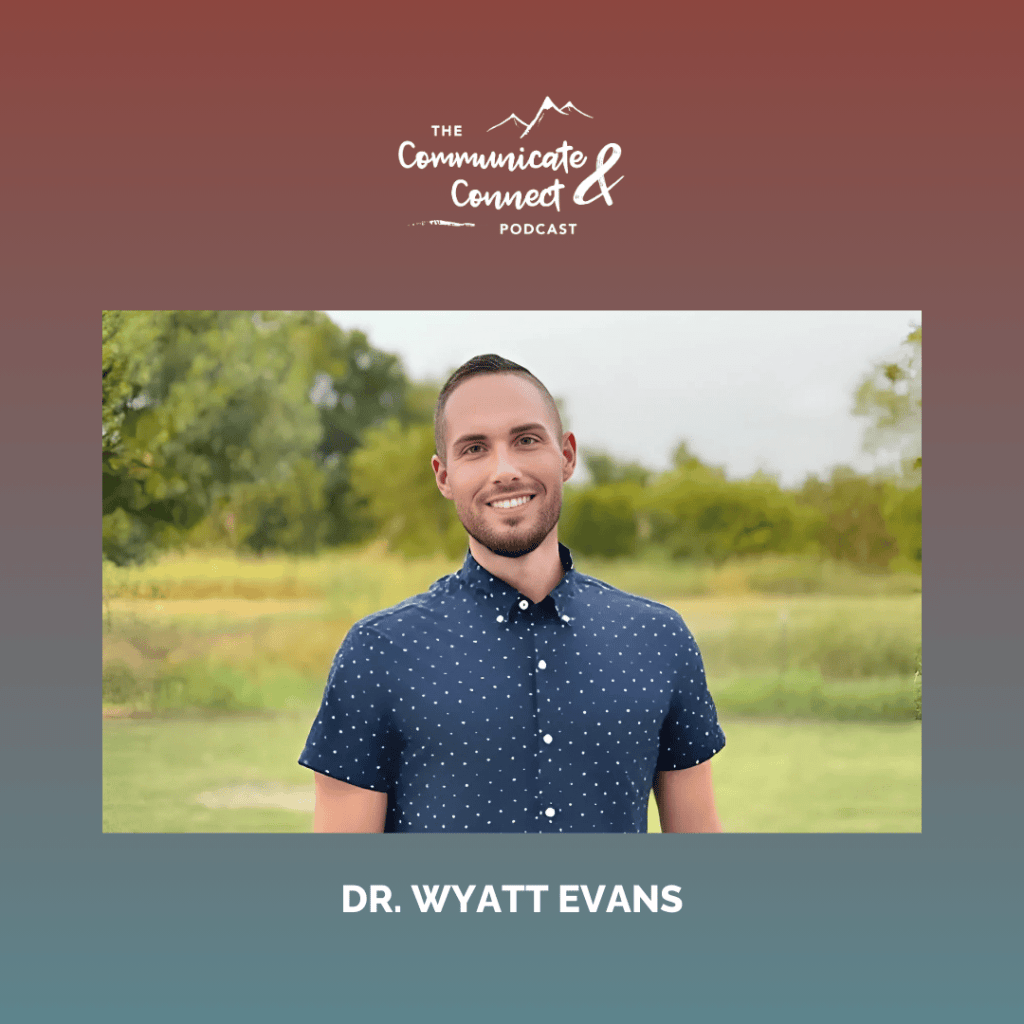
Dr. Wyatt Evans is a distinguished board-certified clinical psychologist who has dedicated his career to improving mental health care, particularly for veterans. He plays a crucial role as a staff psychologist within the VA North Texas Healthcare System’s general outpatient program, where he provides comprehensive care and support to veterans. Beyond his work with the VA, Dr. Evans extends his expertise to a private practice in the Dallas-Fort Worth area, allowing him to reach a broader range of clients.
An avid educator, Dr. Evans currently teaches at multiple institutions, a role he finds immensely rewarding. He is committed to shaping the next generation of mental health professionals through his teachings and mentorship. Outside of his clinical and educational duties, Dr. Evans is deeply engaged in research and writing. His scholarly interests focus on moral injury and resilience enhancement, areas in which he has produced significant work. His approach is heavily influenced by Acceptance and Commitment Therapy (ACT), a framework he frequently employs in both his clinical practice and research endeavors.
Dr. Evans exemplifies a balance of clinical excellence, educational dedication, and scholarly innovation, making significant contributions to the field of psychology and the communities he serves. His work is a testament to his unwavering commitment to enhancing mental health and resilience in individuals facing various challenges.
- Explore the Workbook on Moral Injury to gain insights and practical tools. Get your copy here: https://amzn.to/3lzkUVl.
- Dr. Wyatt Evans offers services in the Dallas/Fort Worth area. Learn more about working with him: https://www.drwyattevans.com.
Free Relationship Pattern Assessment
Many couples assume they have a communication problem when they’re actually stuck in a relationship pattern that keeps creating the same conflict.
Take the free Relationship Pattern Assessment to discover what pattern may be keeping you stuck and learn what to focus on next.
👉 https://pages.communicateandconnect.com/relationship-quiz
Episode Transcript for “Moral Injury with Dr. Wyatt Evans”
Dr. Elizabeth Polinsky [00:00:01]:
This podcast is sponsored by Communicate and Connect Counseling, where we have a team of therapists who provide individual couples and family therapy services, all tailored to meet the needs of military and veteran families. To learn more about our services, visit www.communicateandconnect.com.
Welcome to the Communicate and Connect Podcast for Military Relationships with your host, Elizabeth Polinsky, a military marriage counselor. If this is your first time listening to the Communicate and Connect podcast, please take a second to go, rate, review and subscribe to make sure you get all our future episodes.
We also really want to know what it is you love about our podcast. And if for some reason you’re not loving it, we want to know that too, because we’re committed to providing the best quality content to help you improve your relationships. Listening to episode 11 on moral injury hey everyone, I’m really excited because today I have my friend Dr. Wyatt Evans here who’s going to talk a lot about moral injury.
Dr. Elizabeth Polinsky [00:01:30]:
What is moral injury, how people get it, and how partners can really help their spouse when they think there has been a moral injury. And so to start off, Dr. Evans, could you just maybe introduce yourself?
Dr. Wyatt Evans [00:01:44]:
Sure. So my name is Wyatt Evans. I’m a board certified clinical psychologist. I am primarily working at the moment with the VA North Texas Healthcare System, a staff psychologist in one of the general outpatient programs here. My other roles include a little bit of private practice here in the Dallas Fort Worth area. I’m teaching at a couple different places right now, enjoying that thoroughly. And then in my spare time I do a lot of research and writing in the areas of moral injury, resilience, enhancement. And I spend a lot of that time sort of thinking and writing from an ACT or acceptance and commitment, commitment therapy based perspective.
Dr. Wyatt Evans [00:02:34]:
So I’m really thrilled to be here today to talk about a couple of those areas of interest and passion, Moral injury and ACT for moral injury.
Dr. Elizabeth Polinsky [00:02:45]:
Yeah, I’m really excited you brought up ACT because we actually haven’t talked about acceptance and commitment therapy at all on the podcast yet, which I’m hoping to do that really in depth in the future. Do you have maybe a short spiel about what ACT is?
ACT therapy: evidence-based, enhances resilience, psychological flexibility.
Dr. Wyatt Evans [00:03:04]:
Sure. So acceptance and commitment therapy falls within sort of the third wave of cognitive and behavioral therapies. And it is a process oriented cognitive and behavioral therapy that at this point is evidence based to is an evidence based intervention for pretty much the full range of psychological diagnoses as well as a whole range of non diagnostic or non specific experiences.
I haven’t checked it in the past month or so, but last I checked. We were well over 300 randomized controlled trials supporting the effectiveness of ACT in not only healing, but enhancing resilience, facilitating growth, including growth after trauma.
So again, ACT is sort of a process based therapy that is centered around a core process of psychological flexibility. Psychological flexibility is shown to be associated with healing, again from a number of mental health issues, struggles and experiences. So an ACT therapist works with our clients to help enhance acceptance, mindfulness, clarification of and connection to action on values.
Dr. Wyatt Evans [00:04:30]:
So perhaps today as I’m talking a little bit about how moral injury manifests and how moral healing happens, you’ll hear me talking about some of those processes and you get a little bit more of a sense of what acceptance and commitment therapy does for or with folks.
Dr. Elizabeth Polinsky [00:04:50]:
Yeah, I’m really excited. I really like that the spiel on ACT that you just gave. Yeah, I think my, like one sentence liner sometimes is it’s about accepting painful thoughts and feelings in order to go towards what’s really important to you in life.
Dr. Wyatt Evans [00:05:09]:
Absolutely perfect. One liner.
Dr. Elizabeth Polinsky [00:05:11]:
Yeah, great, thanks. That means a lot coming from you. That’s so validating. So thanks. Yeah, so. So we’ve thrown around the term moral injury. We should probably talk about what is a moral injury. And you are, you know, the expert on this.
Dr. Elizabeth Polinsky [00:05:29]:
I’m sure there are other experts also, but, you know, you just helped write this workbook and so I cannot think of anyone else to ask about this topic other than you. So what, what exactly is moral injury?
Dr. Wyatt Evans [00:05:43]:
Well, so let’s. Let me throw out actually three definitions and I’ll walk through them and we’ll land on a definition of moral injury. It’s kind of hard to talk about moral injury, which is sort of an outcome or an experience, without talking about where it comes from.
So the first definition is of a morally injurious event. So oftentimes in the literature this is an MIE or a pmie, which would be a potentially morally injurious event. These are situations typically occurring in a high state environment where someone perceives that an important moral value has been violated by either their actions or someone else’s actions. And I can unpack this a little bit more as we go, but. So a morally injurious event is sort of the traumatic or stressful event.
Dr. Wyatt Evans [00:06:37]:
That then leads to the second definition I have, which is moral pain. So moral pain, as I and my team define it, is the experience of dysphoric or painful moral emotions, as well as the thoughts cognitions, such as self condemnation that occur in response to a morally injurious event. So something happens. My values are violated by something I did or somebody else did.
And now I’m feeling the pain of that transgression, that violation. That pain may be guilt or shame if I’ve done something that violates my values. That pain may be anger, contempt, disgust if somebody else has done something that violates my values. And the important thing to know about moral pain is that it is a natural, healthy, adaptive process or experience.
Guilt isn’t pathological; poor responses cause moral injury.
Dr. Wyatt Evans [00:07:43]:
It is not in and of itself pathological, meaning it is not in and of itself a form of illness or disorder. If I have done something wrong, I ought to feel guilty. That guilt arises to let me know, to remind me that I have a value that has just been violated. And it that guilt is arising and it’s saying, hey, stop, stop doing that or don’t do that again.
However, if I then go on to relate to that guilt, respond to that guilt, behave in the aftermath or in the midst of that guilt in unhelpful, unworkable, damaging ways, that’s when moral injury manifests. So there are a number of different definitions in the field right now of moral injury.
Early definitions came from fantastic researchers and writers such as Jonathan Shea and Bret Litz. But I and my team define moral injury as the expanded, biopsychosocial and often spiritual suffering that stems from costly, unworkable attempts to manage, control, cope with, or rid themselves of, rid ourselves of moral pain.
Dr. Wyatt Evans [00:09:08]:
So moral injury manifests when I struggle against that moral pain and find myself sinking deeper into the quicksand of suffering, find myself becoming actually more disconnected from my values and from the social contexts that enrich my life.
Dr. Elizabeth Polinsky [00:09:30]:
Okay, that’s, I think I’m following, but I was thinking it might be helpful to have an example of something that would cause moral pain and how that moral pain might be different from a moral injury. Do you have some examples that might help?
Dr. Wyatt Evans [00:09:48]:
Sure. So let me start with a military example and I’ll do that because sort of the moral injury literature is most, or rather moral injury is most represented in the military literature, military history, military psychology. Moral injury is not exclusive to the military.
And we can talk in a moment about how that may manifest in non military settings and contexts. But let me give a military example real quick. So one of the more painfully common experiences that can lead to moral pain and possibly moral injury is that of to just cut to the chase.
Killing a child in a combat scenario. Increasingly these days, in current common warfare tactics, civilians, including children, are in these spaces where warfare is unfolding and a service member May be faced with a situation where either he is or she is ordered to kill.
Moral conflict causes emotional turmoil in soldiers.
Dr. Wyatt Evans [00:10:59]:
A child is faced with a scenario where perhaps the child has been weaponized in some way and is forced into this seemingly impossible choice of taking this child’s life or allowing this child in the weaponized form that they have taken to put the service member or their unit’s life in danger.
Or there’s often, you know, inadvertent scenarios that unfold where the targets are unclear and civilians get caught in the crossfire. To an individual, which is most individuals, by the way, who hold values of caring, for protecting, nurturing, loving children, this incident is inevitably going to elicit moral pain.
A deep sadness, sorrow, regret, remorse, guilt, perhaps even sort of self condemning thoughts. You know, what kind of soldier am I? What kind of person am I? If this person happens to have children of their own? What kind of parent am I?
And these thoughts and these emotions, while immensely painful, are as I said, very natural and in a way adaptive. They keep us from becoming numb or unfeeling to such atrocities. If this service member comes home and let’s say, you know, let’s, for simplicity sake, let’s say this service member has kids of their own. Their kids are about the same age as the kid whose life was taken.
Parental guilt and disconnection from core values.
Dr. Wyatt Evans [00:12:54]:
And every time they see their own kids, every time their kid screams, even that happy scream that little kids have, they are hit with a shockwave of guilt, regret, remorse. They see the face of the kid who, whose life was lost and they find themselves withdrawing, spending less time at home, spending more time in other rooms of the house away from the kid, drinking, or not just away from the kid, find themselves becoming aggressive, standoffish, hostile towards their own kid in an effort to keep them at arm’s length in a way so that they don’t trigger them.
Now this person is not only feeling the guilt and remorse of what happened in country, but they are also becoming more and more disconnected from that value. The caring, the loving, protecting, being there for, nurturing. And so now what was once sort of a very natural, albeit painful moral pain has now become moral injury as it motivates a further disconnection from those moral values of loving and caring and protecting. And in that way, life, in that way, the individual begins to suffer as not only have their moral values been violated, but there’s a perpetuated disconnection from those moral values.
Dr. Elizabeth Polinsky [00:14:25]:
Yeah, so let me make sure I’ve got it. So if caring and nurturing is really important to me and I do something that is like the exact opposite. It’s not caring and nurturing. In your example, it’s like more horrific to like kill a child. I think everybody would really react to that, you know, so the pain that I feel is natural and normal and it actually tells me that I am a caring person.
But when I start not caring for my loved ones because I’m so like bogged down by the guilt and the shame of what I’ve done now, it’s an injury because it’s preventing me from. Almost like if I broke my arm and I know it’s an injury because I can’t move it and I can’t pick up my coffee, you know, or something. It’s, it’s now preventing me from living my life.
Dr. Wyatt Evans [00:15:22]:
Precisely right. So the more one avoids those values. The values and the pain are two sides of the same coin. That is to say, you know, if I didn’t care, then I wouldn’t feel guilt. And the fact that I feel guilt reminds me that I care. It is a sign that my moral compass is still intact.
But if in an effort to rid myself of that guilt, avoid that guilt, keep it at bay, control that guilt, I find myself keeping my value given that it’s just on the other side of that guilt, also at arm’s length, I find myself avoiding, disconnecting from or retreating from that value. Life becomes colorless, meaningless, purposeless.
Dr. Elizabeth Polinsky [00:16:15]:
Yeah, I can, I can really see how this ties in with acceptance and commitment therapy. Yeah, it’s. And I have a million and one questions now as I’m hearing you talk about it, at least for the purposes of our episode here, I’m thinking about other times that might cause a moral injury. Like.
So I’ve, I’ve do mostly couples therapy right now. And you know, a lot of couples are coming to see me to heal from an affair. And there are some couples where there’s been violence. And I actually read recently in one of my classes something like 70% of couples will have an episode of violence at some point in their relationship.
Dr. Elizabeth Polinsky [00:17:01]:
I’d have to, I’d have to like go back and find it to make sure I’m citing it correctly, you know, but it’s, it was, it was high. And so when I’ve had couples where there has been violence, there’s been a lot of that like guilt and that shame. And I guess I’m wondering would those types of things qualify as a moral injury or moral pain or how that relates to a non military or type of relationship dynamic?
Dr. Wyatt Evans [00:17:28]:
Absolutely. So, you know, there is some, I Just want to kind of put this out there at the beginning. There is some debate in the field right now around sort of what constitutes a morally injurious event, sort of, you know, as I mentioned, it’s something that is at least at this moment understood to occur in sort of a high stakes context.
That means the likelihood or the presence of physical or psychological threat is significant. So what that means exactly what the boundaries of that are remain a little vague at the moment. So I’m just going to kind of put that out there for consideration and for kind of caveating purposes, I suppose. But then let me say. Yes, okay, Yes.
Dr. Wyatt Evans [00:18:17]:
I think that it is my opinion that what you’re describing absolutely could constitute a morally injurious event, especially, especially in those scenarios of violence that you were describing. So if one partner perpetrates violence on another and the. The person who is being perpetrated against genuinely feels like their life or their physical integrity is in danger and is being threatened by a loved one, by a trusted person, then this could absolutely lead to moral injury.
Relationship violence can lead to moral injury.
And I would point to the fact that it could lead to moral injury for both partners. So something that I failed to, I think adequately describe a few minutes ago when talking about morally injurious, these events could be acts of commission, meaning my meaning actions that were taken, perpetrations if you will, active transgressions by me, myself, an act of commission by self. Or it could be an act of commission by another.
So let’s imagine for a moment married couple and one partner is under a great deal of stress, a great deal of pressure. Let’s assume perhaps that this partner was consuming alcohol to cope with that stress.
Dr. Wyatt Evans [00:19:52]:
In a moment the other partner said something, did something, not warranting violence, of course, but triggering violence. Let’s say this has never happened before. In fact, the angry and now intoxicated partner is actually typically a very loving, caring, kind and compassionate person. And those are values of theirs. They then become violent towards their partner doing physical harm and psychological harm. By that physical harm. Both of these individuals are very likely to experience moral pain. The perpetrator is likely to experience guilt, shame, regret, remorse.
Dr. Wyatt Evans [00:20:35]:
They’re likely to arrive on the other side of this incident and when perhaps they’re a bit more clear eyed, feel incredibly guilty for their behavior and have incredibly self condemning thoughts. And these would not be inappropriate either, given their values of loving and caring and compassion.
The person perpetrated against that, the partner who was hurt here may also experience moral pain, anger, contempt. This sense of betrayal with which they Will also likely grapple. And so moral pain may flow through either of those folks or both of those folks in the aftermath of this kind of event.
Dr. Elizabeth Polinsky [00:21:24]:
Yeah. So for the person who became violent, they would have moral pain. And when it stopped them from then caring about their partner moving forward, that’s when it would be a moral injury.
Guilt indicates moral violation, prompts corrective action.
Dr. Wyatt Evans [00:21:37]:
We’re on the right track here. This could go in a number of ways, but let’s say that the perpetrator feels immense guilt afterward. Well, I would be so bold as to say they ought to. Right. You have just violated your moral values of caring and kindness and compassion and loving, of not hurting your partner.
So that guilt is an adaptive emotion and it lets you know that you’ve messed up. Now, there are a couple of different ways that we can respond to that guilt. If I respond to that guilt by withdrawing from my partner, feeling myself to be a monster who can’t be trusted.
Dr. Wyatt Evans [00:22:19]:
If I withdraw from my partner feeling that I am, or believing myself to be unforgivable, unworthy of my partner’s love and continued commitment, if I opt to immediately end the relationship rather than explore where my values and my partner’s values might take me now, I am likely suffering with moral injury.
Dr. Elizabeth Polinsky [00:22:49]:
I had a lot of curiosity about the other partner, the partner that now has the anger and the moral pain from the anger of being hurt. And how does that look if it turns into a moral injury? And how might that be different if they were the one who was on the more receiving end of a moral violation?
Dr. Wyatt Evans [00:23:13]:
Right. So that individual would not be, I would submit, would not be wrong for feeling angry, for feeling contemptful, disgusted with their partner’s behavior, for feeling saddened, sorrowful at this betrayal of trust. Often times partners have shared values. That’s why they developed their partnership. Not only has the perpetrator violated their own values, but these values were likely shared by the victim here, the survivor here. And so again, the moral emotions that are being experienced are not wrong. They’re not maladaptive or pathological. However, once again, it’s how we respond to those emotions that is especially meaningful.
Dr. Wyatt Evans [00:24:08]:
So if this person, and you know, if this person notices that anger and becomes consumed in and by that anger and it sort of departs from their own values aligned path, then they may too find themselves suffering in moral injury. If they sort of retract from even the possibility of restoration of this relationship or worse, I don’t know if worse yet, if further, they perhaps they end this relationship, but then they retract from ever pursuing another romantic relationship at all.
They find themselves isolating from anybody who could do them harm. Out of a sense that people are just sort of monstrous people who will betray you now. They are. Their life is being directed in unhelpful ways by their moral pain.
Dr. Elizabeth Polinsky [00:25:08]:
Yeah, that makes a lot of sense. And it’s reminding me of some of the clients that I’ve worked with in the past where they experienced sexual trauma of some kind and then they, they have not wanted to be in relationships after that.
PTSD vs. Moral Injury: Key Differences Explained
Dr. Wyatt Evans [00:25:24]:
Right. And it, and it can be that, you know, so we should distinguish just real quickly, without getting into the weeds too much between sort of ptsd, post traumatic stress disorder and moral injury. So if what we’re primarily looking at is sort of a fear response, that is the survivor becomes consumed by sort of an exaggerated or distorted fear response, then we might be looking at more a PTSD presentation.
But if what we’re struggling with is sort of a contempt or a disgust and a distrust that unfolds from that, that people will not adhere to their values. People are untrustworthy. I’m not necessarily afraid of everybody, but I just, I find everybody to be dishonest. I find everybody to be hiding something or otherwise sort of untruthful about their values. Now we’re looking at something that might be unfolding in the moral realm, not so much fear based.
Dr. Elizabeth Polinsky [00:26:37]:
Yeah, I think that’s a really helpful distinction. So thank you for adding that. So I guess the next question is how does someone heal from a moral injury?
Moral injury interventions: Ongoing research and treatm
Dr. Wyatt Evans [00:26:48]:
That’s a very good question and one that is sort of still under investigation. So there is not necessarily A1 evidence based intervention that has been sort of most clearly established as the frontline intervention. Go to intervention for moral injury. There have been several studies that have investigated frontline PTSD treatments and their effectiveness with moral injuries.
So there is preliminary evidence supporting the effectiveness of prolonged exposure therapy, cognitive processing therapy. There have been a couple other treatments that are currently being investigated to see how effective they are in intervening on moral injury, Adaptive disclosure and the impact of killing protocol. Notably, these have been mostly investigated in military or veteran samples. I am a bit biased, but what I will point to is acceptance and commitment therapy and its potential in supporting moral healing.
Dr. Wyatt Evans [00:28:03]:
So I’ll just throw out my final definition of the day and it’s a bit of a lengthy one, so bear with me. But sort of, as we were thinking about developing this acceptance and commitment therapy intervention for moral injury, we defined moral healing with sort of five qualities.
First, acceptance of the reality of past moral wrongs. So not trying to construe these in some way so as to overlook or make them better, but acknowledging the reality and the gravity of them. Openness to moral pain, including the associated cognitions as an element of but not the entirety of human experience. Again, moral pain is actually adaptive. It supports healthy individuals and more to the point, healthy societies. So moral healing involves an openness to that pain.
Dr. Wyatt Evans [00:29:00]:
It involves flexible consideration of moral rules in favor of underlying moral values. And I can unpack that one a little bit. But the idea here is that moral values, values in general ought to be engaged flexibly. Even our core principles, our guiding values, ought not to be engaged rigidly lest they become another form of avoidance control. So flexible consideration of the rules that sort of function as shortcuts to our values. So let’s say we have a value of loving, right? I’ve got this value of loving that guides the way. So, you know, this is. That’s a fairly high order value for me personally.
Dr. Wyatt Evans [00:29:50]:
And for me, that doesn’t just mean that I love and take care of my family. It doesn’t just mean that I try to give the best care to my patients possible. It doesn’t just mean that I’m involved with my community. It doesn’t just mean that I try to stay connected with and supportive of my friends. It means all of those things.
Now let’s imagine that I have that value and I am also a military service member and I am deployed and I am on the front lines and I am finding myself in a firefight. If one of the rules that I adhere to to try to support my love, my loving is thou shalt not kill, that’s going to be a hard, hard rule to live in line with. If I find myself in a firefight in the battlefield, and I’m going with an extreme example to sort of be illustrative here.
Dr. Wyatt Evans [00:30:49]:
And I get that that’s a bit of an extreme example, but it is actually also a form of loving to protect my fellow service members. It is actually a form of loving to serve my country and protect those folks here. It is actually a form of loving to ensure that I come home, if at all possible, to continue taking good care of my family and my patients and my friends and my community.
But if I adhere rigidly to that rule, I’m probably not going to make it back or my battle buddies aren’t going to make it back. So I don’t know if that’s the easiest example to digest, but it’s a, that’s okay.
Dr. Elizabeth Polinsky [00:31:31]:
I think, I think it’s helpful. Yeah. I was also thinking, and this may not, it’s very less extreme compared to that one. But like, if I valued, like if, if, like, I don’t know if healthy, can healthy be a value?
Dr. Wyatt Evans [00:31:47]:
Sure.
Dr. Elizabeth Polinsky [00:31:48]:
What do you.
Dr. Wyatt Evans [00:31:48]:
Yeah, I think so.
Dr. Elizabeth Polinsky [00:31:49]:
So if like, if my value was healthy and I was like moving towards health, but then I had a rule like I can’t have cake and then it’s my wedding day and I can’t have cake, then like that might be too rigid.
Dr. Wyatt Evans [00:32:03]:
Right, Absolutely right.
Dr. Elizabeth Polinsky [00:32:07]:
Yeah.
Dr. Wyatt Evans [00:32:08]:
I’m following because part of healthy is healthy relationships. And if we’re standing there up in front of everybody and you know, if you’re standing up there in front of everybody and your partner is about to hand you this piece of cake and you’re like, no, no, no, I can’t take that, I can’t eat that. Well, that’s going to make that, that’s going to create a little bit of an awkwardness. Right. So there’s a need to be flexible around values.
Dr. Elizabeth Polinsky [00:32:33]:
Yeah, It’d make for weird photos too.
Dr. Wyatt Evans [00:32:36]:
That it would. Yeah.
Dr. Elizabeth Polinsky [00:32:39]:
Okay, so you were kind of talking us through like the steps of healing or phases.
Moral healing: self-awareness, acceptance, living values.
Dr. Wyatt Evans [00:32:46]:
Yeah. Sort of the qualities that comprise or enable moral healing. There are a couple more sort of awareness of a sense of self that is distinct from moral pain. Oftentimes folks will become sort of enshrouded in their moral pain. The guilt goes from I have done something wrong to I am a guilty person, I’m a shameful person, I’m a monstrous person who is defined by my guilt worthy behaviors.
And so we want to take a good big step back from that and acknowledge that I have guilt, that I am more than my guilt. And lastly, and perhaps most importantly, in a way is actively living values, including those that were previously violated in the present moment and in each moment, from moment to moment. When we’re working from an acceptance, commitment, acceptance and commitment therapy perspective, we’re trying to enable each of those things which for those who might be familiar with act, you’ll notice, sort of map on to some of the core processes.
Dr. Wyatt Evans [00:34:01]:
And so when I’m working with somebody suffering with moral injury and trying to enable moral healing for them, will target each and every one of those processes in service of sort of breaking free from the moral injury and reengaging their values even in the midst of moral pain.
Dr. Elizabeth Polinsky [00:34:18]:
Yeah. And so I know that you just, you have a workbook and so is this workbook. It takes you through these steps and it’s sort of self led Right.
Dr. Wyatt Evans [00:34:27]:
So my colleagues and I composed this workbook book and it’s for anyone who is suffering with moral injury. It is for anyone who is a professional who is working with. So a therapist or a counselor, somebody involved in faith based organization who is working with somebody who is suffering with moral injury or I would submit it would be great for partners of those who are suffering with moral injury to kind of think through the experience that’s unfolding in their loved one and perhaps help enable moral healing.
So, you know, this workbook was the joint effort by Dr. Robin Walzer, Dr. Kent Drescher, and Dr. Jacob Farnsworth. We’ve got a couple other team members, Dr.
Non-clinical moral injury intervention workbook development.
Dr. Wyatt Evans [00:35:20]:
Lauren Borges and Dr. Sean Barnes, who are all working together. We’re all working together to really develop the act for moral injury intervention in a clinical setting. But this workbook in particular is something that doesn’t necessarily require a clinical setting. And it’s three parts. The first just kind of helps folks understand what moral injury is, what moral values are, where our moral values come from.
The second part walks through each of those core processes that I was talking about just a moment ago, including acceptance and mindfulness skills, values clarification and committed action on those values. And then we also have a final part that sort of brings all those processes together to focus on a couple of things that seem to be especially important in healing from moral injury, and that is forgiveness and compassion, especially self compassion.
Dr. Elizabeth Polinsky [00:36:19]:
Yeah, that sounds really amazing and I’m excited. I haven’t purchased your book yet, but I definitely am going to now that we’ve had this conversation. And I’m excited to like read it and go through it. But I was really glad to hear that you said this could be like a partner. If my spouse or my partner has gone through or is dealing with moral injury and I get this book, it could help me helping them, sort of.
Dr. Wyatt Evans [00:36:49]:
I think so. Yeah.
Dr. Elizabeth Polinsky [00:36:51]:
Yeah. Do you have any other tips or advice for a spouse or a partner of somebody who is sort of dealing with moral injury and trying to achieve moral healing?
Dr. Wyatt Evans [00:37:02]:
Yeah, I’ve got a few things in mind. So the first is probably not especially groundbreaking, but it’s just encourage care. Now, moral injury is not a diagnosis. It is not a disorder, nor would I ever advocate that it be classified in that way. But it is often something that requires sort of professional care of some sort, whether that be a therapist, a counselor, a mentor, a clergy person, a chaplain, somebody who can support in an informed, systemic and purposeful way a recovery and healing process.
So I would certainly Encourage partners of those struggling in the midst of their moral pain to encourage and enable self care, but also encourage and motivate their partners to seek out professional care in whatever manner was most aligned with their values and is sort of matching their level of willingness and open. Another point that I find especially important. And it’s tricky, it’s super tricky.
Avoidance hinders connection; prioritize staying present.
Dr. Wyatt Evans [00:38:15]:
But don’t collude with avoidance. Oftentimes partners are attempting to be helpful to their spouse or to their partner, to their loved one who is suffering. And they will, you know, let’s go back to that very, very first example. And the person with moral injury is sort of triggered by their crying or screaming kid or their rambunctious kid or what have you.
And let’s say their spouse comes in and, you know, sort of whisks the kid away because they know this is triggering to the person suffering with moral injury, but in so many ways that actually deprives the person who is struggling of an opportunity to stay connected and in the present moment, even with that moral pain, but also with the value that is caring for supporting the child right in front of them, the child who is still with their child.
And this can show up in little ways and big ways. We probably don’t have the space and time to unpack them all now. But if you can start noticing what the values are, and this is where some guided work, either with a professional or with the workbook or in another way might be helpful in sort of clarifying the values and then noticing where avoidance of those values is showing up, where all that could be quite helpful.
Dr. Wyatt Evans [00:39:44]:
But if you can start noticing the ways in which your loved one is perhaps avoiding, yes, pain, but also opportunities to engage or reengage with their values, then I would advocate holding them gently in that space, standing with them in that space, and that sort of segues to another point which is just inviting and encouraging connection.
You see, moral injury is a social injury. It’s a social wound. It is a disconnection. It is a fraying of the fabric that binds us together. And so standing with the person in the midst of their moral pain and inviting them to stay in that space and stay connected to their moral values, I think that would be a beautiful, kind, loving, compassionate thing to do.
Dr. Elizabeth Polinsky [00:40:39]:
I really am loving all of those sort of like take home points about what I can do that are sort of like action items if my partner is going through this. So I think we’re about out of time, Dr. Evans.
So thank you so much for being on this podcast episode and for Sharing all of this knowledge that you have about moral injury and moral healing and providing some really great examples to sort of wrap our minds around this a little bit abstract idea. So I do want to just ask, like, if people would like to work with you or if they want to get this workbook, how would they go about doing that?
Dr. Wyatt Evans [00:41:21]:
Sure. Yeah. I think probably the easiest way would be to make a quick visit to my website, which is drwyattevans.com so just d r w y a t t e v a n s.com and there you can find a couple things that you might find interesting or helpful. First is just a link to the workbook. It’s published by New Harbinger Publications and you can find it on their website. I think the link on my website takes you to Amazon.
Dr. Elizabeth Polinsky [00:41:54]:
And the title, what’s the title of the book?
Dr. Wyatt Evans [00:41:57]:
So it’s a very long title. This is traditional with New Harbinger Publications, so the best way to find it is just to search the Moral Injury Workbook. So far it’s the only one.
Dr. Elizabeth Polinsky [00:42:08]:
All right. Okay. Perfect. It won’t be hard to find.
Dr. Wyatt Evans [00:42:13]:
No, no.
Dr. Elizabeth Polinsky [00:42:13]:
Okay.
Dr. Wyatt Evans [00:42:14]:
Yeah. And there at my site you can also find some other publications from my team on sort of these definitional distinctions that I’ve talked about. And if you are in the North Texas area and you or your loved one is sort of struggling with moral pain, suffering with moral injury, and you’d like to reach out to me about therapy services, you can do that there as well.
Dr. Elizabeth Polinsky [00:42:39]:
Wonderful. And Oli will include links to all of that in the show, notes for people to find pretty easily.
Dr. Wyatt Evans [00:42:46]:
Thanks.
Dr. Elizabeth Polinsky [00:42:47]:
So thank you so much, Dr. Evans, for being on this podcast. I have really enjoyed it and maybe we can do this again sometime.
Dr. Wyatt Evans [00:42:56]:
Well, thank you very much for inviting me and giving me this space to talk about something that I am very passionate about and share some information that will hopefully be helpful to your listeners. And I would be glad to come back and chat with you anytime on.
Dr. Elizabeth Polinsky [00:43:19]:
I hope you enjoyed today’s episode. If so, please take a second to go, rate, review and subscribe so you get all of our future episodes. Make sure to check out the show notes to sign up for our free 10 week relationship email course.
This email course is really designed for people who are maybe having trouble with communication or connection in their relationship and helping them develop some quick wins right away to start improving it. While I am a therapist, this podcast is for educational purposes only and is not considered therapy and it should also not be a replacement for therapy. If you think you need a professional of any kind. You should definitely go find one.
Until next time


